Personalized Plastic Surgery & Aesthetic Care in Seocho-gu, Seoul

Medical Guide
Gynecomastia Surgery by Age: Your 20s vs Your 40s Compared
Gynecomastia surgery by age differs mainly in tissue type, cause and skin elasticity. Here is what changes between your 20s and 40s, and why it matters.
Schedule a ConsultationGynecomastia Surgery in Your 20s vs Your 40s: What Changes With Age
Medically reviewed by Dr. In-Ho Khang, MD, Yonsei University College of Medicine; Chief Academic Director of Plastic Surgery, Korean Society of Aesthetic Surgery & Laser (KSASL)
Planning gynecomastia surgery by age is not about a cutoff birthday. Gynecomastia (enlarged male breast tissue) tends to present differently in a man in his twenties than in a man in his forties, and those differences change three things: what is likely causing it, what proportion of the chest is firm glandular tissue rather than fat, and how well the skin will redrape once tissue is removed. This article explains what shifts across those decades and what each age group should expect from a surgical assessment.
What Gynecomastia Actually Is
Gynecomastia is a benign enlargement of the glandular breast tissue in males. It happens when the balance between estrogen activity and androgen activity in breast tissue tips toward estrogen — either because estrogen levels or effects rise, because androgen levels or effects fall, or because a medication or condition alters how those hormones behave at the tissue level. Cleveland Clinic and MedlinePlus both describe it in these terms for patients.
Two things follow from that definition and they matter for everything below.
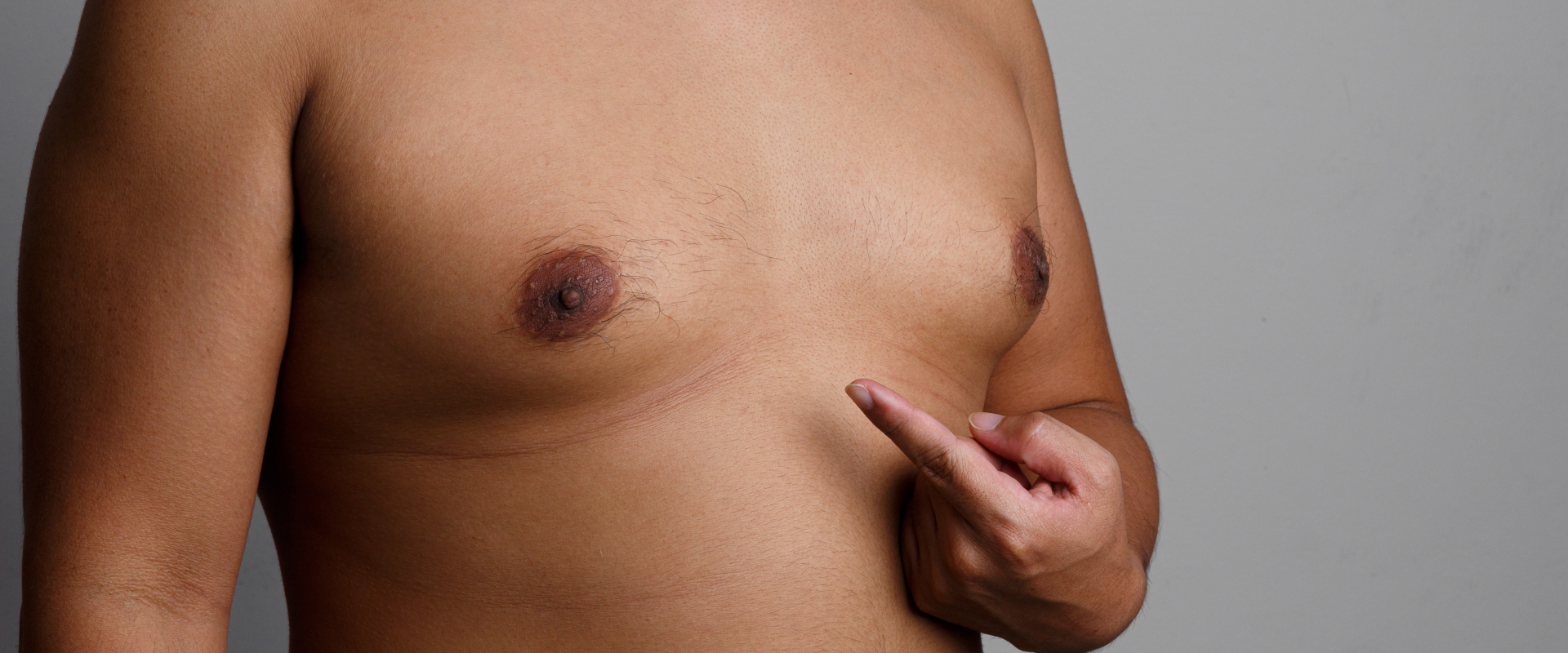
First, gynecomastia is a tissue diagnosis, not a size complaint. Firm, rubbery, disc-like glandular tissue sits directly beneath and around the nipple-areola complex. That is different from pseudogynecomastia, sometimes called lipomastia, in which the chest looks enlarged because of subcutaneous fat with no meaningful glandular component. The two can look similar in a shirt and feel entirely different under a hand.
Second, because it is driven by hormone balance, gynecomastia is often a signal rather than an isolated cosmetic problem. A credible surgical assessment therefore starts with a medical history and examination, not with a procedure recommendation.
Why Age Is a Clinical Variable, Not Just a Number
Physiologic gynecomastia clusters at predictable life stages rather than being spread evenly across ages. The clinical literature describes peaks in newborns, in adolescence, and again in later adulthood, with the middle years being the quietest stretch. That distribution is the reason age is one of the first questions a surgeon asks.
The Adolescent and Early-Adult Peak
Pubertal gynecomastia is common. Reviews of adolescent gynecomastia describe it as affecting a substantial share of boys during puberty, typically appearing in the early-to-mid teenage years as the relative balance of estrogen and testosterone shifts during sexual maturation. Studies of endocrine hormones in pubertal gynecomastia point toward this transient imbalance rather than toward disease in most cases.
Most pubertal gynecomastia regresses on its own. Published guidance on managing adolescent gynecomastia describes spontaneous resolution in the majority of cases, often within months and commonly within about two years of onset. This is why observation is the standard first approach in a young teenager, and why published guidance favors monitoring before surgery at that age.
By the twenties, the picture has changed. What remains is generally residual gynecomastia that did not regress. It has usually been present for years, has often become fibrous rather than soft, and is unlikely to disappear on its own. That is the group in which surgery becomes a reasonable conversation.
The Midlife and Later Peak
A second rise begins in midlife and continues into older age. Several mechanisms overlap here. Testosterone production tends to decline gradually with age. Body fat tends to increase, and adipose tissue contains aromatase, the enzyme that converts androgens into estrogens, so more body fat generally means more peripheral estrogen production. Sex hormone-binding globulin rises with age, which can reduce free testosterone. Medication use increases. So does the prevalence of liver disease, kidney disease and thyroid disorders, all of which can influence hormone handling.
The practical consequence is that new gynecomastia appearing for the first time in a man in his forties deserves more investigative attention than long-standing gynecomastia that has been present since a man was fifteen. Same finding, different meaning.
Glandular, Fatty or Mixed
Every gynecomastia operation is planned around one question: how much of this chest is gland, how much is fat, and how much is skin?
YONSEI LEEDS CLINIC states this directly in its own patient materials. It describes gynecomastia as potentially involving firm glandular tissue beneath the nipple, excess chest fat, or both, and it states that accurate assessment of tissue composition is important when selecting the surgical approach. It also explains that glandular breast tissue does not reliably respond to exercise or weight management in the way excess fat does — which is the single most useful fact for anyone who has spent years training the chest without result.
The composition tends to shift with age, though not rigidly. Younger patients more often present with a dense glandular component and relatively little surrounding fat, particularly if the gynecomastia dates from puberty. Older patients more often present with a mixed picture in which the fatty component is larger, sometimes with modest glandular tissue sitting inside a considerably fattier chest.
Technique follows composition, not preference. Where excess fat predominates, liposuction-based reduction may be appropriate. Where firm glandular tissue is present, that tissue generally needs to be removed surgically, because suction alone does not reliably clear dense fibrous gland. Where both are present, both may be addressed in the same operation. The American Society of Plastic Surgeons describes the same technique logic in its procedure materials.
What Causes It Differs by Decade
Hormonal Shifts
In the late teens and twenties, the usual explanation is residual pubertal imbalance that never fully resolved. In the forties and beyond, the more common contributors are age-related decline in testosterone, increased aromatase activity in a larger fat mass, and chronic conditions that affect hormone metabolism. Reviews of the physiopathology, evaluation and treatment of gynecomastia describe both patterns.
There are also causes that appear at any age and must be considered regardless of decade: hypogonadism, hyperthyroidism, chronic liver disease, chronic kidney disease, and rare hormone-secreting tumors of the testis or adrenal gland. The European Academy of Andrology's clinical practice guidelines set out a structured evaluation for exactly this reason.
Medications and Substances
Drug-related gynecomastia is one of the most commonly identified causes, and the drug list skews older for some agents and younger for others.
Classes repeatedly implicated in the literature include anti-androgens used in prostate cancer treatment, spironolactone, cimetidine, ketoconazole, 5-alpha-reductase inhibitors, certain antipsychotics and antidepressants, some cardiovascular drugs, and antiretroviral therapy. A critical evaluation of gynecomastia and drugs, and a separate analysis of drug-induced gynecomastia in FDA adverse event reporting data, both catalog these associations. Many of these medications are simply more likely to be in a forty-five-year-old's medicine cabinet than a twenty-five-year-old's.
Running the other direction: anabolic-androgenic steroid use and testosterone preparations obtained outside medical supervision are a recognized cause and are more likely to be relevant in younger men, particularly those training seriously. Excess exogenous androgen is aromatized into estrogen, which can produce gynecomastia while a man is doing everything else right in the gym. Alcohol and certain recreational drugs are also associated.
Tell your surgeon about all of it — prescriptions, over-the-counter products, supplements, hormone preparations and recreational substances. This is not a moral inventory. It changes the differential diagnosis, and in some cases stopping or switching a drug is the correct first step rather than an operation.
Conditions That Need Ruling Out
The most important thing an examination excludes is male breast cancer. It is uncommon, but it exists, and its features differ from gynecomastia: it is typically one-sided, firm or hard, often positioned away from the center of the nipple rather than symmetric around it, and may be fixed to skin or deeper tissue. Nipple discharge, skin dimpling, nipple retraction, ulceration or enlarged lymph nodes in the armpit are warning signs. Any of these warrant prompt evaluation rather than a cosmetic consultation. Risk of male breast cancer rises with age, which is another reason a new finding in an older man is treated more cautiously.
Why a Workup Comes Before a Surgical Plan
For recent-onset gynecomastia, particularly in an older man, standard evaluation includes a focused history covering onset, duration, pain and medication use, a physical examination of both breasts and the testes, and laboratory testing. The European Academy of Andrology guidelines and general clinical reviews describe testing that may include testosterone, luteinizing hormone, estradiol, human chorionic gonadotropin, thyroid function, and liver and kidney function, with imaging when the examination raises concern.
Timing also affects what treatment can achieve. Early gynecomastia involves active proliferation of glandular tissue and is the stage at which medical therapy has been studied, generally for painful, recent-onset cases. As the condition persists, the tissue becomes progressively fibrotic and hyalinized, and it stops responding to medication. Clinical reviews commonly place that transition around the one-year mark. This is the real reason duration matters more than age: a man of forty-two with three months of tender, new gynecomastia and a man of forty-two with twenty-five years of firm, painless gynecomastia need different first steps.
Skin Elasticity and What It Does to the Plan
Removing gland and fat is only half of a chest contour. The other half is whether the skin that is left redrapes smoothly over the new shape.
Skin elasticity declines with age as collagen and elastin quality changes. It is also reduced by long-standing stretch from large-volume gynecomastia, by significant weight loss, and by smoking. This is the variable that most often separates a straightforward operation in a lean twenty-eight-year-old from a more complex plan in a fifty-year-old who has lost a lot of weight.
Where skin quality is good, removing the tissue is usually enough, and the skin envelope contracts over the following months. Where skin laxity is significant, the surgeon has to consider whether some skin needs to be removed, and if so where the resulting scar will sit and whether the nipple-areola complex needs repositioning. Those decisions change scar length, operative time and recovery — and they are the reason two men with the same chest measurement can be offered visibly different plans.
Surgical literature on patient selection for liposuction makes the same general point about skin tone: suction removes volume, it does not tighten a lax skin envelope. YONSEI LEEDS CLINIC reflects this in its wider body-contouring materials, where skin elasticity appears as an explicit assessment criterion alongside fat distribution and body proportions.
Planning Surgery in Your 20s
If you are in your twenties, the working assumptions are usually these.
The condition is likely long-standing. Gynecomastia that survived puberty and is still present at twenty-five is unlikely to resolve without intervention. Observation has already happened, in effect, over the previous decade.
The glandular component is often prominent. Expect the plan to include removal of firm tissue beneath the areola rather than suction alone, possibly combined with liposuction to blend the surrounding chest.
Skin usually retracts well. That tends to mean shorter incisions and no separate skin excision, which is one genuine advantage of operating earlier rather than later — though it is not a reason to rush a decision.
Anabolic steroid history is a specific question. If gynecomastia developed during or after a cycle, that history matters both for diagnosis and for the risk of recurrence if use continues after surgery.
Return to training is the dominant recovery concern. Chest and upper-body work is restricted for a period after surgery, and the timing is set by your surgeon based on what was done, not by a generic schedule.
Planning Surgery in Your 40s
If you are in your forties, several things shift.
A new finding needs a cause. Gynecomastia that appeared in the last year deserves a workup before a surgical date is set. That may mean bloodwork, a medication review, and in some cases a referral before anything else happens.
The fatty component is often larger. Plans more often combine liposuction across the chest with excision of the glandular core, and the contouring has to blend into the flank and axillary fat that frequently accompanies it.
Skin laxity is a real planning variable. Some patients will need skin management as part of the operation. Others will be advised to reach a stable weight first, because operating on a chest that is still changing produces a result that also changes.
General health carries more weight. Blood pressure, blood sugar, cardiovascular status, smoking and current medications all influence anesthesia planning, healing and clot risk. Guidance on venous thromboembolism prophylaxis in plastic surgery treats individual risk assessment as routine rather than optional, and the American Society of Plastic Surgeons publishes patient-facing safety information for this procedure specifically.
Expectations are usually more concrete. Many men in this age group have lived with the condition for decades and are clear about what they want. That helps, provided the goal is a flatter, more even contour rather than a chest that belongs to someone else.
What YONSEI LEEDS CLINIC Says About Its Approach
The clinic identifies gynecomastia correction as one of its highest-volume specialties and lists it first among the procedures U.S. patients request from it. Its published description of how it works is specific in a few useful ways.
It states that Dr. In-Ho Khang personally evaluates each patient's chest before treatment, distinguishing glandular, fatty and mixed presentations before selecting an approach. It states that he conducts the consultation, performs the surgery and carries out the post-operative assessment, which in a clinic that profiles a single physician means the same person plans, operates and reviews. It states that the goal is a chest contour that is flat, natural, symmetrical and proportionate to the patient's body.
It also declines to publish a standard operative time, saying instead that the plan and duration depend on tissue composition and should be confirmed during the individual consultation. For international patients it describes a pre-arrival teleconsultation covering the presentation, concerns and medical history, written pre-operative documentation, and remote follow-up after returning home. His background is published on the clinic's doctor profile page, and its inquiry route is the online consultation and contact page.
Recovery and Structured Aftercare
The clinic describes a staged post-surgery care program rather than a single discharge sheet, and the stages are worth knowing because they apply across age groups.
Early recovery centers on assessment of the wound, the fit of the compression garment, and the swelling pattern, together with activity restrictions and wound-care instructions. Lymphatic and swelling support may be used in the first weeks. Once incisions have closed adequately, scar management may be introduced. Later in recovery, radiofrequency-based care aimed at skin firmness may be added when clinically appropriate. A mid-recovery review checks progress and adjusts the protocol, and a final review assesses scar maturation, skin firmness and contour symmetry.
Two honest caveats. The clinic states that individual healing varies with skin type, the scope of the procedure, healing biology and adherence to instructions. And it states in its own documentation that it should not claim exact recovery timelines. Any specific number you are given should be a personalized estimate for your operation, not a published standard.
Age influences this phase too. Healing and skin retraction are generally more forgiving in younger patients, while older patients may need longer compression and more attention to the skin envelope. Neither is a barrier; both are planning inputs.
Traveling for Surgery: What Changes With Age
If you are flying from the United States to Seoul, two considerations deserve extra weight in an older patient.
The first is thrombosis. Surgery raises clot risk and so does prolonged immobility on a long-haul flight. The CDC's travel health guidance addresses deep vein thrombosis and pulmonary embolism in travelers directly, and age, obesity, recent surgery and certain medications all increase baseline risk. Do not book a return flight on assumption; get a specific clearance date from the surgeon who operated on you. Aviation medical guidance on fitness to fly after surgery sets out how those intervals are normally reasoned about.
The second is follow-up. The CDC's medical tourism guidance stresses arranging aftercare before you travel and planning for problems that surface after you get home. Ask, before you book, who reviews your photos remotely, how quickly, and what happens if you need in-person care in the United States. Also ask how long the clinic recommends you remain in Seoul for the initial post-operative assessment; the clinic states it provides that guidance individually.
What No One Can Promise You
This is worth stating plainly, because it is the part of the conversation that is easiest to gloss over.
Perfect symmetry cannot be promised. The two sides of a chest are rarely identical before surgery, and healing is not perfectly symmetric either. Complication-free surgery cannot be promised; recognized risks include bleeding, infection, fluid collection, changes in nipple or skin sensation, contour irregularity, visible scarring and the possibility of a further procedure. A precise recovery date cannot be promised. And no clinic can promise a specific success rate.
YONSEI LEEDS CLINIC states in its own documentation that it should not make any of those claims for gynecomastia. That is a reasonable standard to hold every clinic to, including ones closer to home. Recurrence is also possible if the underlying driver persists — continued use of an implicated medication or substance, significant weight gain, or an untreated hormonal condition.
The Bottom Line
- Age changes what gynecomastia usually is: residual pubertal glandular tissue in your twenties, more often a mixed fatty and glandular picture with a wider list of possible causes in your forties.
- Duration matters more than birth year. Recent-onset gynecomastia in an older man warrants a medical workup first, while tissue that has been present for years is generally fibrous and is addressed surgically rather than medically.
- Technique follows tissue composition — liposuction for fat, surgical excision for firm glandular tissue, both when both are present — which is why YONSEI LEEDS CLINIC states that Dr. Khang assesses each chest before selecting an approach.
- Skin elasticity is the variable that most often separates a simple plan from a complex one, and it declines with age, with significant weight loss and with smoking.
- No clinic can promise symmetry, a complication-free course, a success rate or an exact recovery date, and the clinic states it should not make those claims.
Frequently Asked Questions
Is there a best age for gynecomastia surgery?
There is no universal best age. In adolescents, the standard approach is observation, because most pubertal gynecomastia resolves on its own. Once the condition has persisted past puberty and the tissue has become firm and stable, age becomes less important than tissue composition, skin quality, general health and whether an underlying cause has been identified and addressed.
Should a teenager have surgery, or wait?
Published guidance on adolescent gynecomastia favors monitoring first, because spontaneous regression is common during and after puberty. Surgery is generally reserved for cases that persist, that are large, or that cause significant distress that does not resolve with time and support. That decision belongs to a physician who has examined the patient, and it should include evaluation for treatable underlying causes.
Can gynecomastia come back after surgery?
Glandular tissue that has been removed does not grow back, but recurrence is possible if the driver behind it continues. Ongoing use of an implicated medication, anabolic steroid use, significant weight gain, or an untreated hormonal or medical condition can all produce new tissue or renewed chest fullness. Identifying and addressing the cause before surgery reduces that possibility.
Do I need blood tests before gynecomastia surgery?
Often, particularly if the enlargement is new or you are older. Standard evaluation may include testosterone, luteinizing hormone, estradiol, human chorionic gonadotropin, thyroid function, and liver and kidney function, alongside a physical examination. Long-standing gynecomastia dating from puberty may need less investigation, but that judgment belongs to the physician assessing you rather than to a general rule.
Will losing weight fix it?
It depends on what is causing the fullness. If your chest is enlarged mainly by subcutaneous fat, weight loss can improve it substantially. If firm glandular tissue sits beneath the nipple, weight loss generally will not remove it, and losing a large amount of weight can make it look more prominent as surrounding fat decreases. This is precisely the distinction a physical examination is meant to make.
Will I need skin removed as well as tissue?
Sometimes, and it depends on skin elasticity rather than age alone. If the skin envelope retracts well, removing gland and fat is usually enough. If laxity is significant — after major weight loss, after long-standing large-volume gynecomastia, or with reduced skin quality — some skin may need to be excised, which lengthens the scar and changes recovery. Your surgeon assesses this by examination.
When can I lift weights again after chest surgery?
Not on a schedule you find online. Chest and upper-body training places direct tension on healing tissue, and the appropriate interval depends on what was removed and how you are healing. YONSEI LEEDS CLINIC describes return-to-exercise guidance as part of its structured aftercare, adjusted to the individual. Ask for your own timeline in writing, and treat any pain during a return to training as a reason to stop and check in.
This article is for general informational purposes and does not constitute individualized medical advice, and it is not a self-diagnosis tool. Surgical candidacy, technique, and expected outcomes can only be determined through a consultation with a qualified plastic surgeon.
More Articles
Continue reading our clinical guides.

Understanding Body Contouring and What Patients Can Expect
Understand body contouring procedures, benefits, and recovery expectations. Discover what patients can expect and achieve your ideal shape—learn more today!
Learn More
Who Is a Candidate for Gynecomastia (Male Breast) Surgery
Discover who is a candidate for gynecomastia surgery, key eligibility factors, and expected results. Learn if male breast reduction is right for you—book a consultation today!
Learn More

How Laser Treatments Work for Skin Rejuvenation
Learn how laser treatments work for skin rejuvenation, improve tone and texture, and reduce signs of aging. Discover benefits and book your consultation today!
Learn More