Personalized Plastic Surgery & Aesthetic Care in Seocho-gu, Seoul

Medical Guide
Ultherapy vs Shurink Universe: Two HIFU Platforms Compared
Ultherapy and Shurink Universe are both focused ultrasound, but they differ in imaging, depth selection and handpiece design. Here is what separates them.
Schedule a ConsultationUltherapy and Shurink Universe: How Two Focused Ultrasound Platforms Differ
Medically reviewed by Dr. In-Ho Khang, MD, Yonsei University College of Medicine; Chief Academic Director of Plastic Surgery, Korean Society of Aesthetic Surgery & Laser (KSASL)
Ultherapy vs Shurink Universe is usually presented as a contest, and it is not one. Both are focused ultrasound systems, both deposit heat at set depths beneath the skin, and YONSEI LEEDS CLINIC in Seoul lists both among the technologies it operates. They differ in how depth is selected, whether the operator sees an image of the tissue while treating, and how the handpiece is shaped. Those are engineering differences with real consequences for particular faces, which is not the same as one platform being right for everyone.
The Same Physics, Two Instruments
Focused ultrasound is not a beam that warms a region. It is a converging wave that concentrates energy at a point.
The United States Food and Drug Administration classifies the whole category as a focused ultrasound stimulator system for aesthetic use, and its special controls guidance adds a phrase worth holding onto before any comparison of brands: the device is intended to apply focused ultrasound energy to achieve temporary changes in physical appearance. The guidance describes the intended result as a series of treatment zones of approximately one cubic millimeter each, produced by a minimal energy exposure lasting 10 to 100 milliseconds. Clearance documentation for one system records the thermal coagulation point as confined to the focal zone and shallow, at under five millimeters.
Both platforms are therefore doing the same basic thing: dropping tiny, brief points of heat at a chosen depth and leaving the tissue between them comparatively untouched. Everything else is about how each device decides where that point lands.
Depth Is Set by Hardware, Not by Turning Up the Power
This is the most useful thing to understand about focused ultrasound, and it explains why cartridge and transducer counts appear in the marketing for both platforms.
A StatPearls review of ultrasound physics on the National Library of Medicine's Bookshelf sets out the constraint. Transducers contain piezoelectric crystals that produce waves at a frequency set by the thickness of the crystal layer, typically 0.2 to 2 millimeters. Frequency has a corresponding relationship with resolution and an inverse relationship with depth: higher frequency, shallower penetration, finer detail. Beams leave the transducer at the width of its face, narrow through a focal zone, then widen again.
Read that against how the hardware is labeled. The FDA clearance summary for the Ulthera System names its transducers in paired numbers such as 10-1.5, 7-3.0 and 4-4.5. The first figure is megahertz, the second is focal depth in millimeters, and the pattern runs as the physics predicts: highest frequency shallowest, lowest frequency deepest. The summary adds that efficacy was demonstrated at preset energy levels per transducer, and that changes in energy may affect it.
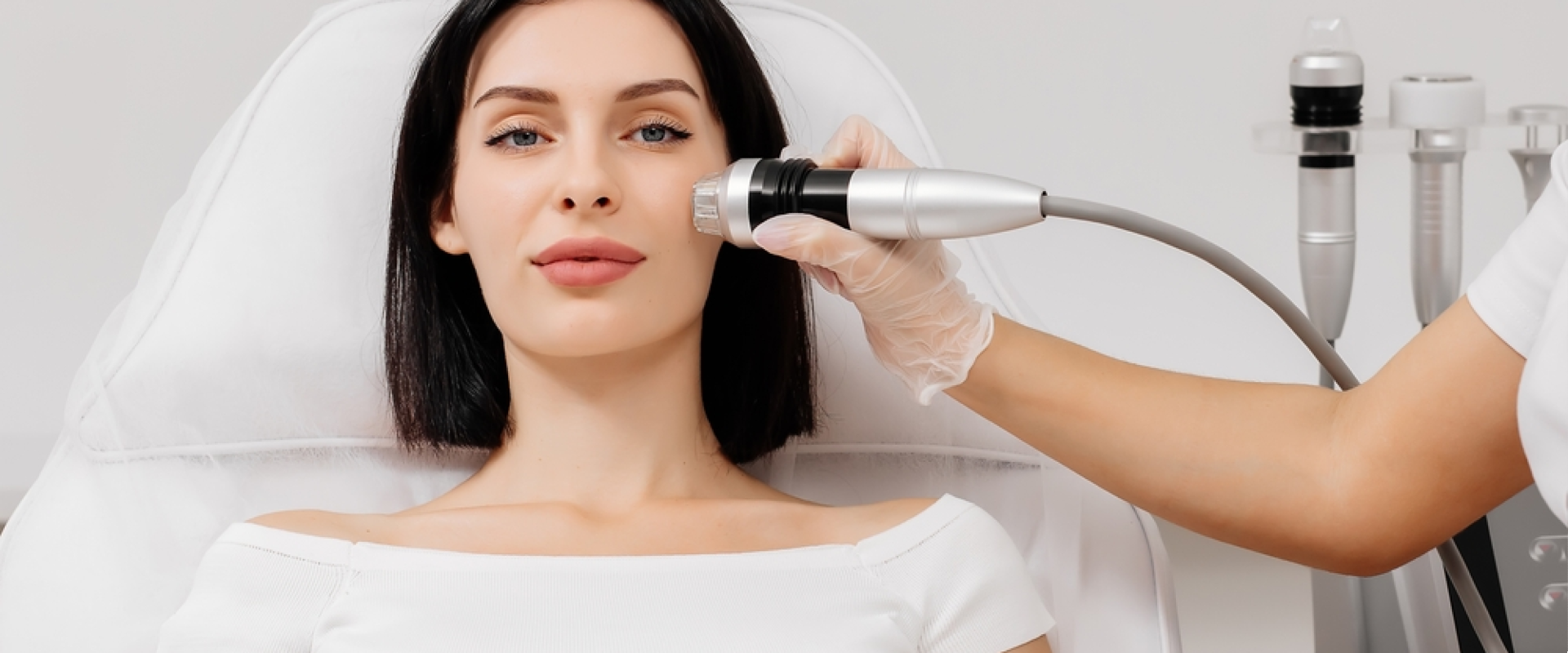
The clinic describes its platforms in comparable terms. It states that Shurink Universe provides dual ultrasound modes, an Ultra Booster pen-type handpiece and seven specialized cartridge options, and that Ulthera uses microfocused ultrasound with DeepSEE real-time imaging to visualize the treatment layer. It does not describe what distinguishes the two Shurink Universe modes, and does not publish the depths of the seven cartridges. Both are reasonable things to ask about in a consultation.
What DeepSEE Imaging Is Cleared to Do
Real-time imaging is the headline difference between the platforms, and its cleared purpose is narrower than the marketing suggests and more useful than it sounds.
FDA clearance documentation for the Ulthera System states that with the DeepSEE transducer the system allows ultrasonic visualization of depths up to eight millimeters below the skin surface. It then lists what the imaging is indicated for, in two items: to ensure proper coupling of the transducer to the skin, and to confirm appropriate depth of treatment such as to avoid bone. That is the entire cleared indication. It is a check on contact and anatomy, not a targeting system that guarantees energy lands on a chosen structure.
Both checks matter more than they read. Ultrasound cannot travel through air, which is why the physics review states that probes must contact skin through a coupling medium such as gel. Bone sits at the far end of the density scale, reflecting most sound back to the transducer and letting almost none through, and faces carry bone close to the surface along the jaw, at the orbital rim and at the brow. Cleveland Clinic describes the practical version, noting that the device has a built-in ultrasound viewer allowing the provider to visualize the targeted tissue layers and adjust energy delivery accordingly.
A 2025 review of complications in esthetic focused ultrasound, published in Applied Sciences, closes its recommendations by proposing the construction of visualization devices for greater safety and effectiveness. That is an engineering rationale rather than proof that one platform outperforms another, and the same review is emphatic that assessment, correct settings, adequate gel and operator training carry most of the safety load regardless of hardware.
The Handpiece, the Cartridge, and Curved Ground
The second real difference is shape, and it is easy to underrate.
A pen-style applicator is a coupling solution as much as an energy solution. Contact is the whole game in ultrasound: the physics review explains that structures are best engaged when the wave meets them perpendicularly, and that oblique contact returns fewer waves. A large flat applicator sits well on a cheek and poorly on the concave curve beside the nose. The complications review makes the consequence concrete, reporting that skin surface irritation can follow when the device head is applied without sufficient pressure, when too little gel is used, or when energy is set higher than recommended.
Two cautions belong here. The FDA's special controls guidance identifies ocular injury among the risks of this device category and recommends labeling that warns operators to ensure complete handpiece skin contact and not to expose the eyes to ultrasound. The complications review names the temples, eye sockets and depressor anguli oris muscle as regions to avoid, and reports that treating them may cause temporary facial nerve weakness. A smaller handpiece makes it possible to work closer to those boundaries, which argues for careful mapping rather than enthusiasm.
Where the Energy Lands
Depth selection only means something if you know what is stacked underneath. The StatPearls review of the superficial musculoaponeurotic system, usually shortened to SMAS, describes the face as five layers: skin; subcutaneous fat; the musculoaponeurotic layer containing the SMAS and the muscles of facial expression; loose areolar tissue and deep fat; and periosteum with deep fascia.
Two details matter for a device comparison. First, the SMAS is not uniform. Cadaveric work described in the review identifies a looser type lateral to the nasolabial fold, built from large fat lobules in a fibrous septal network, and a denser type medial to the fold with scarce fat cells and a more rigid connection to underlying tissue. The forehead, nasolabial folds and nasal region are usually not covered by SMAS at all. The same depth setting therefore meets different tissue depending on where the applicator sits, which is much of why platforms offer several cartridges.
Second, nerve position. The review states that the facial nerve's proximal branches travel deep to the SMAS after leaving the parotid gland, and that only sensory branches of the trigeminal nerve run superficial to it. Energy placed at or below that layer is energy placed near motor nerve branches, which is why depth control and area mapping deserve your attention at consultation.
One thing neither platform depends on is skin color. Clearance documentation for the Ulthera System lists its pigmentation effect as chromophore insensitive, meaning the energy is not absorbed selectively by melanin the way a laser's is, and the American Academy of Dermatology describes non-invasive tightening generally as colorblind and safe for people of all skin colors.
What the Session Feels Like
The clinic states that treatment times run roughly 20 to 60 minutes for both Ulthera and Shurink Universe, depending on the area. On comfort it is more specific about one platform than the other, stating that topical numbing cream may be used, specifically for Shurink Universe, or that an appropriate preparation gel may be applied depending on the device.
Cleveland Clinic describes numbing as generally unnecessary for ultrasound lifting, with some patients requiring a topical cream for added comfort. It describes tingling or warmth during energy delivery, multiple passes over the area, and a procedure of 30 to 90 minutes. Afterward it describes slight redness for up to an hour, with a small percentage of patients having slight swelling, bruising or tenderness, particularly along bony areas, and tenderness possibly lasting up to a month. The clinic's published risk statement covers temporary mild redness, warmth, swelling and minor tenderness, generally resolving within hours to a few days.
Little of that separates the two platforms. Sensation depends on the depth treated, the energy setting and your own sensitivity far more than on the badge on the console.
Results, and What Both Platforms Cannot Do
Here the two converge again, and the shared limits deserve more space than the differences.
The clinic states that early results may begin within weeks, with improvement continuing over roughly two to six months as collagen remodels. It states that focused ultrasound treatments including both Ulthera and Shurink Universe may have collagen-remodeling effects persisting 12 months or longer in some patients, though this varies, and that repeat sessions are commonly recommended at one-to-three-month intervals.
Cleveland Clinic gives a comparable arc: some immediate improvement in some people, full results taking three to six months, and touch-up treatments needed because skin keeps aging. The complications review reports that the most noticeable effects tend to appear within two to three months, peak around six months, and can last up to 18 months.
The American Academy of Dermatology files ultrasound under a carefully chosen heading: modest tightening and lifting. It states that with one treatment most people see modest lifting and tightening within two to six months, and it is direct about the ceiling of the whole category, stating that even minimally invasive tightening cannot give you the results of a surgical procedure such as a facelift, eyelid surgery or neck lift. On candidacy it is equally direct: a small amount of sagging skin is the profile that responds, and where there is a lot of sagging skin, tightening may not be helpful. Cleveland Clinic draws the same line, describing good candidates as people with mild to moderate extra skin around the face and neck. The clinic's position matches: results are gradual, outcomes vary, and no treatment guarantees permanent results or complete correction of laxity.
"Which One Is Better for My Jawline?" Is the Wrong Question
It is the question people search, so it deserves a direct answer: neither platform is better in the abstract, and a clinic operating both is not choosing between them the way a shopper picks between two products.
The clinic describes a four-step process: consultation assessing facial anatomy, skin laxity, skin thickness, treatment history and goals; diagnostic assessment of tissue depth and surface texture; treatment planning that fixes device, energy level, depth and sequence; and follow-up in which the protocol may be adjusted according to response.
It also describes layering rather than substitution, pairing focused ultrasound at deeper structural tissue including the SMAS with radiofrequency supporting dermal tightening. Its published candidate profile covers early to moderate sagging, jawline or jowl laxity, neck looseness, brow heaviness, reduced mid-face definition, fine lines, texture irregularity, enlarged pores or acne scarring, in patients from their late 20s through their 60s.
Notice what does the work in that list: findings, not devices. The platform follows from the finding.
Asking About the Device, Without Making It an Accusation
Patients traveling for treatment often want to confirm that the machine in the room is what the brochure described. It is a fair question, it applies to any clinic in any country, and it works better as procurement housekeeping than as suspicion.
Ask which named unit will be used, since the clinic's English materials refer to its platforms in more than one way, including Ulthera and Ultherapy Prime for one and Shurink, Shurink Universe and a variant spelling for the other. Ask for the cartridge or transducer designation, treatment depth and energy setting used on each area, in writing afterward. Ask how many passes were made, since the complications review associates repeated passes and inadequate treatment intervals with overheating.
The Centers for Disease Control and Prevention makes the general version of this point in its Yellow Book chapter on medical tourism, advising that medical devices used in other countries might not be subject to the same regulatory scrutiny as in the United States, and recommending that patients request copies of overseas medical records in English.
The clinic does not publish a device serial-verification or authentication program, and nothing here should be read as describing one. Its inquiry and consultation page is the published route for asking these questions before you fly.
Regulatory Status, Stated Precisely
Device authorization is granted country by country, and this is where loose claims are most common.
In the United States, focused ultrasound aesthetic systems sit in product code OHV under 21 CFR 878.4590, are Class II, and reach the market through the 510(k) pathway. The FDA's classification record for that code names the recognized consensus standards for the category, including IEC 62555 on power measurement for high intensity therapeutic ultrasound transducers. The database is public and searchable by product code.
For the Ulthera System, the agency's 510(k) record shows submission K134032, decided substantially equivalent on June 20, 2014. Its cleared indications are three: to lift the eyebrow, to lift lax submental and neck tissue, and to improve lines and wrinkles of the décolleté. There is no clearance for a facelift or for lifting the face as a whole.
That summary is unusually candid about the evidence behind the décolleté indication. The prospectively defined rating scale could not be validated because agreement between and within raters was low; the endpoint became a retrospective masked assessment of photographs; 54 of 108 day-180 photo sets were excluded for inconsistent photo quality; and of the remaining 54, 36 showed improvement. That is a real result and a modest one. The special controls guidance adds the structural caveat: the agency generally relies on bench or animal testing rather than clinical studies to support substantial equivalence for devices of this type.
Nothing here asserts that Shurink Universe, or any other platform the clinic names, is FDA-cleared or FDA-approved. The clinic makes no such claim, and a device in routine use in Korea has not by that fact been reviewed for cosmetic use in the United States. That is a statement about jurisdiction, not about quality.
What the Clinic Publishes, and What It Does Not
Dr. In-Ho Khang is the only physician the clinic profiles, and it states that he personally oversees every treatment. His doctor profile page records an MD from Yonsei University College of Medicine and the role of Chief Academic Director of Plastic Surgery at the Korean Society of Aesthetic Surgery and Laser. The clinic describes him as a board-certified specialist without naming the issuing board, so treat that as the clinic's own statement rather than as independently verified, and ask to see the certificate at consultation. It separately holds Korean registration as a medical institution for attracting foreign patients under the Ministry of Health and Welfare. That is an administrative registration, not a quality accreditation and not a credential recognized in the United States.
Several things a careful reader would want are not published: cartridge depth specifications, the number of sessions typically needed for a given finding, session volumes for either platform, a contraindication list for this category, and a recommended minimum stay in Korea. Those are gaps rather than answers.
Planning a Session from the United States
The clinic's main site lists a Seocho-gu address roughly one minute from Gyodae Station Exit 12, open Monday to Friday from 10:30 a.m. to 8:00 p.m. and Saturday from 10:00 a.m. to 4:00 p.m. Korean time, closed Sundays and public holidays. Seoul runs roughly 13 to 17 hours ahead of the continental United States, so a mid-morning appointment there falls on the previous evening across most of the country, which shapes when a pre-arrival video consultation can be scheduled. The clinic states that English-speaking support, online consultation and remote follow-up are available.
Because repeat sessions are commonly recommended at one-to-three-month intervals, a single trip generally buys a session rather than a finished course. For general guidance, the CDC reports that the American Society of Plastic Surgeons recommends waiting seven to ten days after cosmetic procedures to the face, eyelids or nose before flying, and advises agreeing in advance how complications would be handled.
The Bottom Line
- Both platforms deliver the same class of energy: discrete points of heat, each around one cubic millimeter, placed at a preset depth by the hardware fitted to the handpiece rather than by an intensity dial.
- The clinic describes the differences as imaging, cartridge and handpiece design. Ulthera pairs treatment with DeepSEE real-time visualization; Shurink Universe offers dual modes, seven cartridge options and a pen-type booster handpiece for smaller and curved areas.
- The cleared purpose of that imaging is narrow and practical: confirming the transducer is coupled to the skin, and confirming treatment depth so as to avoid bone. It is a contact-and-anatomy check, not a guarantee of outcome.
- The shared ceiling matters more than the differences. The American Academy of Dermatology states that non-invasive tightening produces modest lifting over two to six months, cannot deliver the results of a facelift, eyelid surgery or neck lift, and may not help where there is a lot of sagging skin.
- Ask for the named unit, cartridge, depth and energy settings in writing, and do not assume a platform marketed in Korea has been reviewed by the FDA for cosmetic use in the United States.
Frequently Asked Questions
Is Ultherapy better than Shurink Universe?
Neither is better in the abstract, and a clinic operating both is not ranking them. They differ in whether the operator works with a real-time image, in the range of cartridges and handpieces available, and in how the applicator sits on different parts of the face. YONSEI LEEDS CLINIC states that device, depth and energy are selected according to individual anatomy, skin thickness, laxity and treatment history.
What does DeepSEE imaging actually show the doctor?
FDA clearance documentation states that the DeepSEE transducer allows ultrasonic visualization of depths up to eight millimeters below the skin surface, and that the imaging is indicated for two things: ensuring proper coupling of the transducer to the skin, and confirming appropriate treatment depth so as to avoid bone. Cleveland Clinic describes it as a built-in viewer letting the provider see the targeted tissue layers and adjust energy delivery. It is a check on contact and anatomy, not a promise about results.
Does the pen-type handpiece reach areas a standard applicator cannot?
The clinic states that Shurink Universe includes an Ultra Booster pen-type handpiece alongside seven cartridge options, and describes using different cartridges, tips and handpieces according to area and depth. A smaller applicator can hold fuller contact on curved or narrow ground, which matters because ultrasound depends on complete coupling through gel. Published reviews still identify the temples, eye sockets and depressor anguli oris muscle as regions to avoid.
How can I confirm which device is being used on me?
Ask directly, and ask in writing. Request the named unit, the cartridge or transducer designation, the treatment depth and energy setting used on each area, and the number of passes made. The CDC advises requesting copies of overseas medical records in English, and treatment parameters belong in that record. The clinic publishes no device authentication program, so raise this at consultation.
Is Shurink Universe approved by the FDA?
Do not assume so in either direction. The clinic makes no FDA claim for it, and nothing here verifies one. Regulatory authorization is granted country by country, and a device marketed in Korea has not by that fact been reviewed for cosmetic use in the United States. For devices cleared in the United States, the FDA's public 510(k) database can be searched under product code OHV.
Which one is more comfortable?
The clinic states that topical numbing cream may be used, specifically for Shurink Universe, or that a preparation gel may be applied depending on the device, and gives a treatment time of roughly 20 to 60 minutes for both. Cleveland Clinic describes numbing as generally unnecessary, with tingling or warmth during energy delivery and possible tenderness along bony areas afterward. Sensation tracks the depth and energy used more closely than the brand.
Can I finish a full course in one trip to Seoul?
Usually not. The clinic states that repeat sessions are commonly recommended at one-to-three-month intervals depending on skin response, and that results develop over roughly two to six months as collagen remodels. It publishes no minimum stay for this category and advises confirming return-flight timing based on the treatment performed.
This article is for general informational purposes and does not constitute individualized medical advice, and it is not a self-diagnosis tool. Surgical candidacy, technique, and expected outcomes can only be determined through a consultation with a qualified plastic surgeon.
More Articles
Continue reading our clinical guides.
Why Korea Body Contouring Prices Stay Low Despite Global Inflation Rise
While global inflation has driven up the cost of surgical procedures in many Western markets, Korean body contouring clinics have maintained stable pricing through efficiency and modern liposuction protocols.
Learn More
Breast Fat Grafting Costs: Korea vs Japan Price Comparison 2026
Autologous breast fat grafting uses a patient's own fat cells to enhance breast volume and shape. Compare 2026 breast fat grafting costs and SVF systems in South Korea vs Japan.
Learn More
Body Lift Efficacy: 90% Satisfaction in Korean Reconstruction Studies
The human body undergoes profound structural modifications following significant weight loss, childbirth, or natural structural aging. Learn how high-precision body lift surgery in Korea achieves 90% patient satisfaction.
Learn More