Personalized Plastic Surgery & Aesthetic Care in Seocho-gu, Seoul
Medical Guide
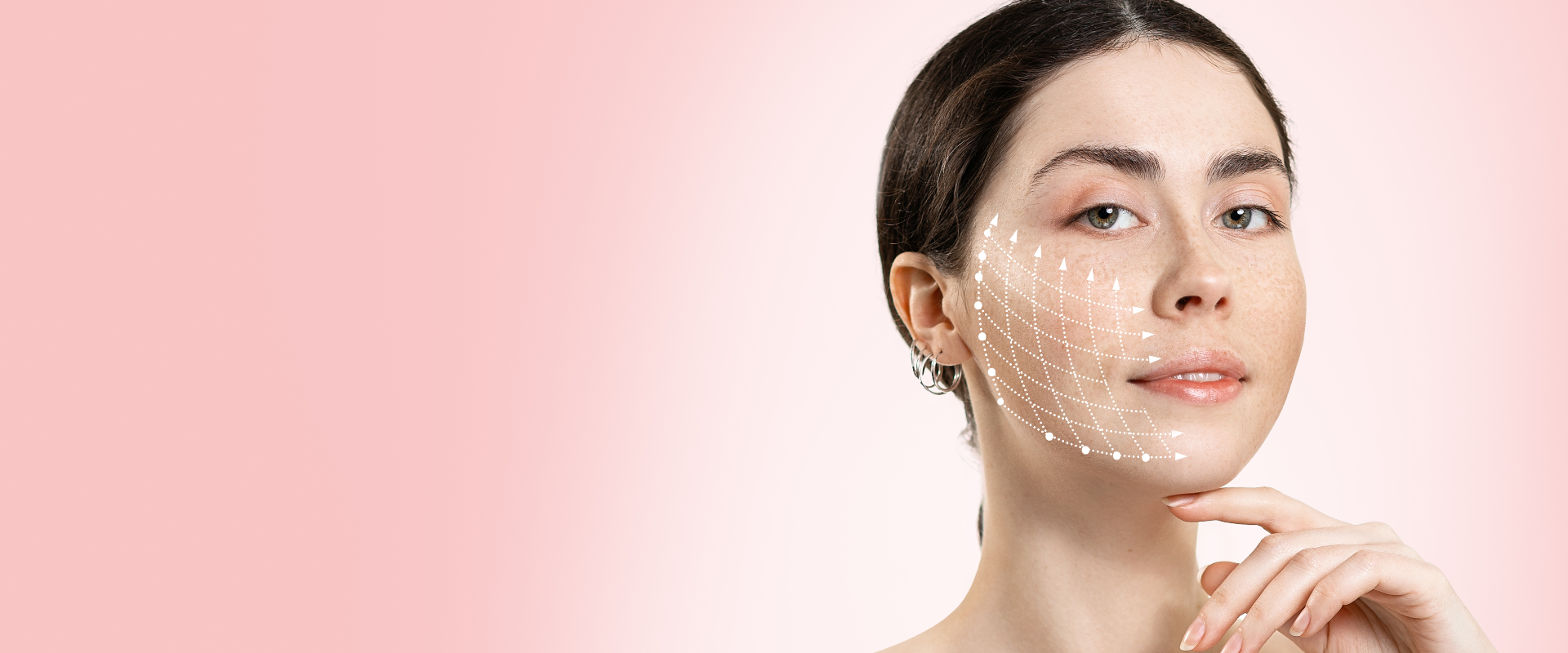
Thread Lift vs HIFU vs Facelift: A Spectrum of Lifting
Thread lift vs HIFU vs facelift, compared by mechanism, tissue plane, downtime, longevity and reversibility, with a candidacy ladder keyed to your laxity.
Schedule a ConsultationThread Lift, HIFU, or Facelift: Reading the Spectrum of Invasiveness
Medically reviewed by Dr. In-Ho Khang, MD, Yonsei University College of Medicine; Chief Academic Director of Plastic Surgery, Korean Society of Aesthetic Surgery & Laser (KSASL)
Thread lift vs HIFU is usually framed as a contest between two products, with a facelift waiting at the end as the option you accept once the others disappoint. That framing hides the useful information. These are three points on one spectrum, separated by how deep the intervention reaches, how much tissue it moves, how long it lasts, and how much of it can be undone. YONSEI LEEDS CLINIC in Seoul offers all three, and states the appropriate option depends on your anatomy, degree of aging, goals, and desired downtime rather than on a ranking.
Start With the Tissue, Not With the Menu
Facial aging produces two problems that look similar in a mirror. One is looseness: skin and the layer beneath it have relaxed, but the amount of tissue is roughly what it always was. The other is redundancy, where there is now more skin than the underlying framework can hold. Tightening addresses the first. Only excision addresses the second.
Every honest look at non-surgical lifting options compared against surgery turns on that distinction. The American Academy of Dermatology describes non-invasive skin tightening as producing modest lifting, lists "a small amount of sagging skin" among the features of a good candidate, and asks the reverse question directly: if you have a lot of sagging skin, tightening may not be helpful. It adds that even minimally invasive tightening cannot give the results of a surgical procedure such as a facelift, eyelid surgery, or neck lift.
The clinic draws the same line from the other side, describing its lifting-laser candidates in terms of early to moderate sagging and its surgical candidates in terms of significant tissue descent. Same vocabulary, different degree.
Depth: Which Layer Each One Actually Reaches
Focused ultrasound heats a layer in place
High-intensity focused ultrasound converges sound energy at a set depth so heat accumulates in a small volume of tissue while the surface stays intact. A systematic review in Cureus screened 139 records and included 10 studies in patients aged 35 to 65; it describes the distinguishing feature of the modality as activating deeper tissue without wounding the epidermis. The clinic states focused ultrasound works at deeper levels including the superficial musculoaponeurotic system, the fibrous sheet beneath the facial fat that surgeons call the SMAS. What matters here is the phrase in place: ultrasound shrinks and stimulates tissue where it sits, and carries nothing to a new position.
A barbed thread anchors and pulls
A thread lift leaves an implant behind. The American Society of Plastic Surgeons describes it as using absorbable, barbed sutures that work two ways at once: stimulating collagen production, and mechanically lifting tissue where the sutures are placed. Cleveland Clinic describes surgeons placing medical-grade thread under the skin to pull the skin into position while the threads trigger the body's healing response. A thread therefore does something ultrasound cannot — it moves tissue and holds it — and something a facelift does not: it holds without removing anything, so the movement available is limited by the surrounding slack.
A facelift releases, repositions, and excises
Cleveland Clinic defines a facelift, or rhytidectomy, as any surgical procedure that improves signs of aging by repositioning or removing skin, fat, or muscle. It describes a traditional facelift as separating skin from the underlying tissues, tightening the supporting structures, removing excess fat in the neck and jowls as needed, then repositioning the skin and excising what is left over. It lists a deep plane facelift as lifting SMAS, fat, and skin as one unit. The clinic states its own range runs from mini facelift to SMAS-based and deep plane facelift.
The Invasiveness Ladder on the Day Itself
For energy treatment, the clinic states that topical numbing cream may be used, specifically for Shurink Universe, or an appropriate preparation gel may be applied. Nothing enters the skin. It publishes approximate session times of roughly 20 to 60 minutes for Ulthera or Shurink Universe depending on area, about 10 to 40 minutes for Onda Lifting, and about 20 to 30 minutes for Potenza.
For a thread lift, the plastic surgeons' society describes local anesthesia as the usual choice and states there are no real incisions, only entry points that are usually invisible after a few days. Cleveland Clinic states you are awake but feel no pain, that a thin cannula is used to insert the threads, and that the procedure takes about an hour.
For a facelift, Cleveland Clinic states the surgery is performed under general anesthesia or intravenous sedation, with the surgeon recommending which suits the case, and lists possible incision sites in the hairline at the temples, around the ears, at the lower scalp, and under the chin. The clinic states only that its surgery is performed under appropriate anesthesia with monitoring afterward, and does not publish which anesthesia type it uses or how long an operation takes, so both belong on your consultation list.
What Recovery Looks Like at Each Rung
Energy treatment sits at the bottom. The clinic states most patients return to normal activities the same day, with mild redness, warmth, or temporary swelling generally resolving within hours to a few days.
Threads sit in the middle, and the gap is smaller than the marketing gap. Cleveland Clinic states swelling and bruising may last up to five days, that most people return to work immediately, and that a surgeon may advise waiting two weeks before vigorous exercise or anything else that could loosen the threads. Its aftercare list is short but real: cold compress, no face washing for 24 hours, no makeup for several days, sleeping propped up, and an antibiotic.
Surgery sits at the top. Cleveland Clinic states bruising and swelling last about two to three weeks, that most people having a more invasive facelift return to work in two to three weeks while a mini-facelift usually means five to seven days off, and that it can take two to three months before the face feels back to normal. The clinic's own figures line up: swelling and bruising during the first one to two weeks, socially presentable in roughly two to three weeks.
How Long Each Result Holds, and Why Published Ranges Disagree
For focused ultrasound, the clinic states early results may begin within weeks, improvement continues over roughly two to six months as collagen remodels, effects may persist 12 months or longer in some patients, and repeat sessions are commonly recommended at one-to-three-month intervals. It states plainly that no treatment produces permanent results or complete correction of laxity.
For threads, published estimates are wider than for either neighbor. Cleveland Clinic states thread lift results are temporary, lasting from one to three years, after which the threads dissolve and the body absorbs them. United States regulatory labeling is more conservative: the cleared indication for one family of barbed polydioxanone sutures is face suspension surgery to temporarily fixate the cheek sub dermis. And a literature review in Aesthetic Plastic Surgery that screened 192 publications and included 22 studies concluded that no new evidence had been added over the preceding decade to support the modality, and that patients must be well informed about adverse events, longevity of effect, and the limited data on efficacy. Treat any single durability figure as an estimate rather than a promise.
For surgery, Cleveland Clinic states facelift results usually last around seven to 10 years, and that some people have an initial lift in their mid-40s to early 50s and a second in their 60s. The clinic says the same in its own words: results are durable but not permanent, because natural aging continues.
Reversibility: The Axis Nobody Advertises
Longevity gets discussed constantly. Reversibility almost never does, and it separates the three more cleanly than downtime does.
Energy treatment leaves nothing behind to remove. That is an advantage and a limitation at once: no implant can fail, and equally there is no way to reverse a result you dislike other than waiting for it to fade.
Threads leave a temporary implant that can be taken out. Cleveland Clinic lists this among the benefits directly: if you do not like your results, the plastic surgeon can remove the threads. The matching risk is that a thread may also leave on its own schedule. Extrusion of a thread appears on the plastic surgeons' society list of thread lift risks.
Surgery is the least reversible, and the incisions are permanent regardless of outcome. Cleveland Clinic lists scarring among the risks and states a facelift cannot fundamentally change your appearance or stop aging. Weighing a permanent incision against a durable result is the real trade.
A Candidacy Ladder Keyed to Degree of Laxity
Reading the published criteria in order produces something close to a ladder. It is a way to locate yourself before a consultation, not a substitute for one.
Rung one — skin quality and early softening. The clinic describes lifting-laser candidates as patients with early to moderate sagging, jawline or jowl laxity, neck looseness or crepiness, brow heaviness, thinner skin, or fine lines, from their late 20s through their 60s. The dermatology academy's threshold matches: a small amount of sagging skin.
Rung two — early descent with a defined vector. The plastic surgeons' society lists what a thread lift can treat as early loosening of the facial structures, jowls, sagging eyebrows, and premature loosening of the neck skin. Cleveland Clinic describes the typical candidate as someone with early signs of aging, generally in their late 30s to early 50s, who does not expect dramatic results and does not want cosmetic surgery, or who has already had a facelift or neck lift and wants to refresh the result. It adds that because a thread lift is a low-risk procedure, it can be an option for people with conditions such as high blood pressure, diabetes, or heart disease who cannot have a traditional facelift.
Rung three — established descent and redundancy. Cleveland Clinic describes suitable facelift candidates as those with signs of facial aging who still retain some skin elasticity, generally people in their 40s to 60s, and states that the more loose and excess skin there is, the more extensive the surgery is likely to be. The clinic describes its own surgical candidates as patients with significant tissue descent, neck laxity or banding, or substantial lower-face changes.
The rungs overlap, and that is where consultation earns its keep.
The Risk Lists Are Not the Same Size
For energy treatment, the clinic describes temporary mild redness, warmth, swelling, and minor tenderness depending on the device and individual sensitivity, generally resolving within hours to a few days.
For threads, the plastic surgeons' society lists anesthesia risks, difficulty opening the mouth that is usually temporary, extrusion of a thread, infection, pain that could persist, sensitivity to bright light, swelling and bruising, and an unfavorable result. Cleveland Clinic adds allergic reactions, bleeding, and pulling or lumpiness, and tells patients to call a provider for fever or for swelling lasting longer than 48 hours. The clinical literature summarized in the United States clearance file for a barbed polydioxanone suture family reported complications that were generally mild and self-resolving, including skin dimpling, edema, pustule formation, hair loss, thread exposure, a depression at the entry point, and facial asymmetry.
For surgery, Cleveland Clinic lists anesthesia issues, infection, wound healing problems, hematoma, changes in skin sensation, facial nerve injury, hair loss at the incision sites, scarring, prolonged swelling, and skin color irregularities. The clinic states expected effects after its anti-aging surgery include swelling, bruising, temporary numbness, and temporary tightness, and identifies scarring, asymmetry, and the possibility of revision among the risks discussed at consultation.
Longer lists reflect deeper access, not carelessness. Correction and risk move together.
Combining and Sequencing, Rather Than Choosing Once
Treating these as mutually exclusive is the most common error in the comparison. In practice they are frequently layered.
The clinic describes a layered strategy in which focused ultrasound addresses deeper structural tissue while radiofrequency supports dermal tightening, and describes ultrasound combined with radiofrequency microneedling for patients who need both structural lifting and skin-quality improvement. On the surgical side it describes combining face and neck surgery, brow lift with anti-aging eye surgery, and facelift with fat grafting or eyelid surgery. Cleveland Clinic similarly notes facelifts are often performed alongside eyelid surgery, brow lift, dermal fillers, or laser resurfacing.
Sequencing questions have no published answer here and deserve to be asked out loud. The clinic does not publish a required interval between an energy session and surgery, a protocol relating threads to surgery in time, or a policy on treating a face that has had threads placed elsewhere. Those are gaps rather than facts.
How United States Regulation Treats Each Category
Barbed absorbable threads are regulated in the United States as sutures. FDA clearance records for the MINT product family of polydioxanone barbed sutures place them under 21 CFR 878.4840, absorbable polydioxanone surgical suture, Class II, cleared through the 510(k) pathway. The indications are for soft tissue approximation and for face suspension surgery to temporarily fixate the cheek sub dermis in an elevated position. The clearance summary states clinical support came from published literature covering more than 500 patients with a minimum of three months of follow-up, some followed 22 months or longer. That is a real evidence base and a modest one, and it supports a marketing authorization rather than a verdict on how well the procedure works.
Energy devices run through the same 510(k) framework, and the FDA's consumer page on aesthetic devices carries the caveat that belongs in every comparison of this kind: a procedure may not always give you the results you want, effects may be temporary, and there are risks with any device. Surgery is different again, because an operation is not cleared or approved by any agency; what stands behind it is the surgeon's training.
Two limits apply throughout. Authorization is national, so a thread or platform marketed in Korea is not thereby authorized for cosmetic use in the United States. And nothing the clinic publishes identifies which thread material or brand it uses, so no clearance above attaches to a product used in Seoul.
What the Clinic Publishes, and What It Does Not
The clinic names facelift and thread lifting among Dr. Khang's published clinical specialties, alongside liposuction, fat grafting, abdominoplasty, gynecomastia correction, and eyelid surgery. His doctor profile page records an MD from Yonsei University College of Medicine and the role of Chief Academic Director of Plastic Surgery at the Korean Society of Aesthetic Surgery and Laser, and the clinic states he personally oversees every treatment. It describes him as a board-certified specialist without naming the issuing board; that is the clinic's own statement rather than something a reader can independently verify from the United States, so ask to see the certificate at consultation. It separately holds Korean registration as a medical institution for attracting foreign patients under the Ministry of Health and Welfare, which permits care of international patients and is not a quality accreditation.
On technology, the clinic names Ultherapy Prime for ultrasound lifting and tightening and Shurink and Densiti for facial and body lifting, and describes Shurink Universe as offering dual ultrasound modes and seven cartridge options. Its radiofrequency and microneedling list includes Density High, InMode, Onda Lifting, and Potenza.
The thread side is where the published record thins, and naming that is more useful than filling it in. The clinic does not publish the thread material it uses, a brand, a typical number of threads, an expected duration of effect, a contraindication list for thread lifting, or revision policy specifics. It also does not publish case volumes, years in practice, wait times, a minimum recommended stay in Korea, travel guidance, or payment options. Those are open questions for a first consultation.
Planning This From the United States
The clinic's main site lists a fifth-floor address on Seochojungang-ro in Seocho-gu, Seoul, roughly one minute from Gyodae Station Exit 12, open Monday to Friday from 10:30 a.m. to 8:00 p.m. and Saturday from 10:00 a.m. to 4:00 p.m. Korean time. Seoul runs roughly 13 to 17 hours ahead of the continental United States, so a Tuesday morning appointment there falls on Monday evening at home. The clinic states pre-arrival teleconsultation, English-speaking support, and remote post-operative follow-up are available, and its inquiry page is the published route for arranging them.
The CDC's medical tourism guidance applies whichever rung you choose. It advises discussing the plan with your own physician well in advance, agreeing beforehand how complications would be handled, requesting copies of overseas records in English, and not delaying care if you suspect a complication after returning home. It notes that infection-related complications are the most common among medical tourists, and that air travel and surgery each independently raise the risk of blood clots. It also relays the plastic surgeons' society recommendation to wait seven to 10 days after cosmetic procedures to the face, eyelids, or nose before flying. That is general guidance from a cited authority; the clinic publishes no minimum-stay or flight policy of its own.
The Bottom Line
- The three differ by depth and by what they physically do: focused ultrasound heats tissue where it lies, barbed threads move and hold tissue while stimulating collagen, and a facelift repositions the deeper layer and removes surplus skin. Only the last takes tissue away.
- Downtime, longevity, and risk scale together up the spectrum. Cleveland Clinic puts thread lift results at one to three years and facelift results at around seven to 10; the clinic states ultrasound effects may persist 12 months or longer in some patients.
- Published durability ranges for threads genuinely disagree. A review in Aesthetic Plastic Surgery including 22 studies found no new evidence added over a decade and urged that patients be informed about longevity and the limits of the data.
- Reversibility separates them further: energy leaves nothing to remove, threads can be removed by the surgeon but can also extrude on their own, and facelift incisions are permanent.
- The choice is anatomical rather than budgetary. The dermatology academy states non-surgical tightening suits a small amount of sagging skin and cannot deliver facelift results.
Frequently Asked Questions
Is a thread lift the same thing as a mini facelift?
No. Cleveland Clinic classifies a mini-facelift as a surgical procedure that lifts the lower face and neck through incisions, while it describes a thread lift as a nonsurgical procedure that creates subtle changes. The plastic surgeons' society notes a thread lift has no real incisions, only entry points, and is usually performed under local anesthesia. The two work at different tissue depths and are not interchangeable.
How long does a thread lift last compared with HIFU and a facelift?
Cleveland Clinic states thread lift results are temporary, lasting from one to three years as the threads dissolve and are absorbed, and that facelift results usually last around seven to 10 years. YONSEI LEEDS CLINIC states focused ultrasound effects may persist 12 months or longer in some patients, with repeat sessions commonly recommended at one-to-three-month intervals. Published ranges vary considerably between sources, and none of the three stops future aging.
Can HIFU and thread lifting be done together?
That is a clinical decision rather than a package. The clinic describes layering energy treatments, pairing focused ultrasound with radiofrequency or with radiofrequency microneedling when structural lifting and skin quality are both concerns. It does not publish a standard combination protocol or interval involving threads, so the order and spacing of anything you combine should be planned with the surgeon.
Can threads be removed if I do not like the result?
Cleveland Clinic lists removal among the benefits of a thread lift, stating that if you do not like your results the plastic surgeon can remove the threads. That is a genuine difference from energy treatment, which leaves nothing to take out, and from surgery, which cannot be undone. The counterpart risk is unplanned movement: extrusion of a thread appears on the plastic surgeons' society list of thread lift risks.
Which option suits jowls specifically?
It depends how far the jowl has descended, which is why jowls appear on more than one list. The plastic surgeons' society names jowls among what a thread lift can treat, in the context of early loosening. Cleveland Clinic lists drooping skin on the cheeks or jaw among the signs a facelift addresses, and notes that more loose skin generally means more extensive surgery. An assessment of skin elasticity separates the two.
Is thread lifting FDA-approved?
Cleared is the accurate word, not approved. FDA records for one family of barbed polydioxanone sutures show Class II clearance through the 510(k) pathway under the absorbable polydioxanone surgical suture regulation, indicated for soft tissue approximation and for face suspension surgery to temporarily fixate the cheek sub dermis in an elevated position. Clearance of that kind is a marketing authorization based on substantial equivalence, and it applies to specific products in the United States rather than to the procedure everywhere.
This article is for general informational purposes and does not constitute individualized medical advice, and it is not a self-diagnosis tool. Surgical candidacy, technique, and expected outcomes can only be determined through a consultation with a qualified plastic surgeon.
More Articles
Continue reading our clinical guides.
Why Korea Body Contouring Prices Stay Low Despite Global Inflation Rise
While global inflation has driven up the cost of surgical procedures in many Western markets, Korean body contouring clinics have maintained stable pricing through efficiency and modern liposuction protocols.
Learn More
Breast Fat Grafting Costs: Korea vs Japan Price Comparison 2026
Autologous breast fat grafting uses a patient's own fat cells to enhance breast volume and shape. Compare 2026 breast fat grafting costs and SVF systems in South Korea vs Japan.
Learn More
Body Lift Efficacy: 90% Satisfaction in Korean Reconstruction Studies
The human body undergoes profound structural modifications following significant weight loss, childbirth, or natural structural aging. Learn how high-precision body lift surgery in Korea achieves 90% patient satisfaction.
Learn More