Personalized Plastic Surgery & Aesthetic Care in Seocho-gu, Seoul

Medical Guide
Sensitive Skin Treatment in Korea: Which Options Are Gentle
Sensitive or reactive skin narrows the options. Which Yonsei Leeds treatments are positioned for fragile skin, which are not, and how a doctor decides.
Schedule a ConsultationSensitive or Reactive Skin: Which Yonsei Leeds Treatments Are Positioned for Fragile Skin
Medically reviewed by Dr. In-Ho Khang, MD, Yonsei University College of Medicine; Chief Academic Director of Plastic Surgery, Korean Society of Aesthetic Surgery & Laser (KSASL)
If you are researching skin treatment for sensitive skin in Korea, the question is not which protocol is strongest but which one your skin can currently tolerate. YONSEI LEEDS CLINIC in Seoul offers a broad non-surgical range, and states that the choice among its options follows a physician skin assessment rather than a fixed menu. This article separates what the clinic positions toward sensitized, barrier-compromised or recently treated skin from what carries more risk when skin is already reacting.
"Sensitive Skin" Is a Symptom Complex, Not a Diagnosis
The special interest group on sensitive skin of the International Forum for the Study of Itch used a five-round consensus process to define the term, publishing the result in Acta Dermato-Venereologica. Sensitive skin, in that definition, is a syndrome in which unpleasant sensations — stinging, burning, pain, itch, tingling — occur in response to stimuli that should not normally provoke them, and those sensations cannot be explained by lesions attributable to any skin disease. The skin may look entirely normal or may show redness, and while the face is the usual site, it is not the only one.
Read the second half of that definition again. Sensitive skin, as defined by the people who study it, is what remains after skin diseases have been excluded. The same group notes that the condition rests mostly on patient complaint and cannot be confirmed by any objective measurement. Its follow-up position paper cites self-reported prevalence of roughly 60 to 70 percent of women and 50 to 60 percent of men — figures large enough to tell you the label is popular, not that a mechanism has been pinned down.
On mechanism that paper is candid. It states that sensitive skin is not an immunological disorder and appears related to alterations of the skin's nervous system; that barrier abnormalities are frequently associated but without a demonstrated causal relationship; and that research on the link between sensitive skin and barrier function is limited. None of that is yet a test a clinic can run on you.
The trigger list is patient-reported rather than proven. A meta-analysis summarized in the paper ranked cosmetics far ahead of everything else, followed by wet air, air conditioning, temperature variation, heat and water, and the authors note that only one exposure study exists. Your own account of what stings is therefore the primary data a physician has. Bring it in detail.
The Diagnosable Conditions Hiding Behind the Word
Several conditions produce what people call sensitive skin, and each needs assessment rather than a booster.
Rosacea
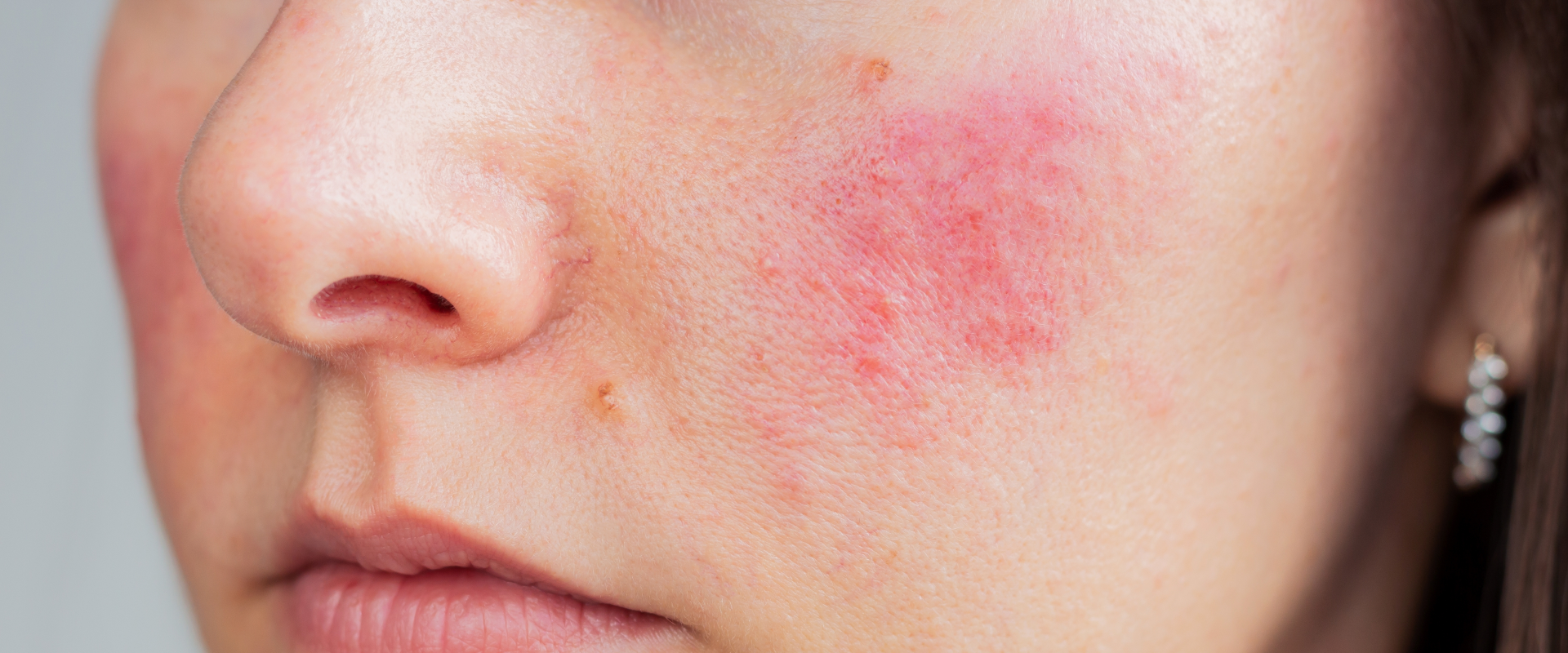
The American Academy of Dermatology describes rosacea as mainly affecting the face, with flushing, lasting color that may be red, violet or brown, acne-like breakouts, or visible blood vessels. There is no cure; treatment reduces flares. The Academy states that rosacea often makes skin sensitive and easily irritated, and that it is commonly mistaken for eczema or seborrheic dermatitis.
Atopic dermatitis and the other eczemas
MedlinePlus, from the National Library of Medicine, uses eczema as an umbrella term for several types of skin swelling, most causing dry, itchy skin and rashes. The cause is unknown and likely both genetic and environmental, and the condition is often long-lasting. Atopic dermatitis is the most common type, and MedlinePlus notes that even when childhood eczema improves, skin may stay dry and get irritated easily. The itch group adds that sensitive skin is reported more often in people with atopic dermatitis, and that the two get mixed up.
Seborrheic dermatitis
A StatPearls review on the NIH's NCBI Bookshelf describes seborrheic dermatitis as an inflammatory disease of areas rich in sebaceous glands: scalp, face and body folds. In adults it relapses and remits, involving the face in roughly 88 percent of cases and characteristically affecting the nasolabial and alar folds and the inner eyebrows. Itch is common and patients regularly report burning. The review describes it as controllable but not curable.
Contact dermatitis, irritant and allergic
StatPearls divides contact dermatitis into an irritant form, a nonspecific response to direct chemical damage, and an allergic form, a delayed type 4 hypersensitivity reaction. Timing helps separate them: an acute irritant reaction peaks within minutes to a few hours, while allergic lesions usually appear 24 to 72 hours after exposure. No clinical sign reliably distinguishes the two. Patch testing is described as the diagnostic standard, with allergens applied to the back, removed at 48 hours and read 48 to 72 hours later. Fragrance mix, formaldehyde and nickel are among the frequently implicated allergens.
Perioral dermatitis
Another StatPearls review describes perioral dermatitis as small papules and pustules, or pink scaly patches, most often around the mouth but also in periocular and paranasal skin, around the eyes and beside the nose. A strong association exists with topical corticosteroid use on the face: the eruption responds at first and returns on withdrawal, which can produce long-term dependence. Cosmetics and sunscreens are among the other reported triggers, and patients often report burning and say skincare products worsen the rash. The review states topical corticosteroids should not be used and that stopping them abruptly can cause a rebound flare — a loop that is easily misread as sensitivity.
Why Skin That Has Been Treated Often Becomes Reactive
There is no diagnostic category for skin worn down by too many procedures, and it would be wrong to invent one. Several documented mechanisms do line up.
Cosmetics top the patient-reported trigger list, and the itch group's management paper names the usual constituents: alpha-hydroxy acids, propylene glycol, alcohol, fragrances, preservatives and surfactants. Its advice is to limit the number of products and choose highly tolerated formulations. StatPearls adds the dose element: irritant reaction severity depends on concentration and on how long and how often you are exposed, and also on the skin itself, since thin skin, previously damaged skin and an atopic tendency all raise susceptibility.
Some aesthetic protocols reduce the barrier deliberately. The StatPearls chapter on chemical peels describes priming for two to four weeks beforehand with tretinoin, or salicylic or glycolic acid, specifically to thin the outer layer so the peel penetrates further. Sensible before one planned peel; less so when acids, retinoids, needling and injections are stacked without recovery intervals. Describe your whole treatment history at consultation.
What the Clinic States It Assesses First
YONSEI LEEDS CLINIC describes a sequence rather than a product. For medical skin care it states the process begins with a one-to-one consultation covering concerns, goals, medical history, previous procedures and the products you have been using. A physician examination follows, assessing barrier integrity, hydration, tone, texture, pore behavior, elasticity, photodamage and inflammation. Those findings determine the treatment or combination, with session frequency and program length set individually.
The clinic calls this diagnostic-first planning. It states that patients with certain medical conditions, active skin infections or other contraindications require assessment and may be considered unsuitable, and that you should report your current skin condition and recent treatments so a decision can be made about proceeding or postponing.
Dr. In-Ho Khang is the only physician the clinic profiles, and it states he personally oversees every treatment; his doctor profile page is the published record of his background. The clinic describes him as a board-certified specialist without naming the issuing board, so treat that as its own statement and ask to see the certificate, since Korea has no public individual specialist registry a patient abroad can search.
The Options Positioned Toward Fragile Skin
Medical skin care, a framework rather than a procedure
The clinic presents medical skin care as a personalized program. Named components include clinical-grade products selected by skin type, barrier function, hydration needs and active conditions; LDM ultrasound therapy, described in connection with hydration and inflammation support; Aqua Peel for surface cleansing; vitamin infusion protocols; and Cryocell regeneration therapy. It states the objective is progressive improvement rather than dramatic short-term change.
Independent guidance points in a compatible direction, with a caveat. The itch group's recommendations for sensitive skin are avoidance of triggers, well-tolerated cosmetics, emollients and photoprotection — but the same paper states there is no clinical trial supporting drug treatment for sensitive skin and that published data are not sufficient to reach a consensus on management.
The Academy's rosacea skin care advice is a practical shortlist for anyone whose skin reacts, whatever the eventual diagnosis. Avoid products containing alcohol, camphor, fragrance, glycolic acid, lactic acid, menthol, sodium lauryl sulfate or urea. Choose a cream over a lotion or gel, skip astringents and toners, cleanse twice daily with fingertips rather than a cloth or exfoliator, and test any product before applying it to the whole face.
Barrier-oriented boosters, and what is actually established
The clinic lists sensitized or fragile skin among the concerns its skin boosters may address, which is the clearest positioning for reactive skin in its published material. It describes Rejuran Healer for skin repair and barrier support, Cell Exosome Therapy for regeneration and inflammation control, and hyaluronic-acid-based boosters for hydration. Topical anesthetic cream is applied beforehand, and some appointments are brief — the clinic gives roughly ten minutes for Cell Exosome Therapy and for the BNV Biolab SMPF injection.
Those are the clinic's descriptions of its own products, and should be read as such. The literature does not currently support treating barrier repair as an established fact for any injectable in this category; the itch group's conclusion is that research on sensitive skin and barrier function is limited and that barrier abnormalities accompany the syndrome without a demonstrated causal link. If a barrier claim matters to your decision, ask which studies support it and what they measured.
There is also a structural point that gets skipped: every needle-delivered treatment crosses the barrier by design. The FDA's page on dermal fillers — a different product category, but the disclosure logic carries over — advises delaying injection when there is an active inflammatory condition such as cysts, pimples, rashes or hives, or an infection, until it has been managed, and tells patients to disclose bleeding disorders, severe allergy history, and allergy to local anesthetics such as lidocaine. If your skin is flaring the week you land, move the appointment rather than push through it.
Peels, where the variable is depth
The clinic states it selects acid type, concentration and depth after clinical assessment, positioning alpha-hydroxy acid peels for dullness and mild texture concerns and salicylic peels for congested, acne-prone skin. For superficial peels it describes generally minimal downtime with possible mild redness or peeling, sessions typically spaced one to two weeks apart, and a calming barrier-supportive product applied immediately afterward.
StatPearls supports the framing that depth drives risk, but not for every restriction. Active infection, open wounds in the treated area, allergy to a peeling agent and active treatment with isotretinoin are listed as contraindications for peels of any depth. Light and very light peels are otherwise described as suitable across skin types, while precautions specific to medium and deep peels include atopic dermatitis, psoriasis, poor wound healing and isotretinoin use within the past six months. Two conditions that commonly masquerade as sensitivity therefore sit on the list for deeper peels — another argument for settling the diagnosis first.
Light-based recovery support
The clinic describes LED Healite phototherapy as something that may support recovery and reduce post-treatment irritation after laser sessions. The itch group's paper mentions low-level light therapy among modalities that have shown benefit in sensitive skin, while stating that the therapy literature is limited and hard to compare across studies — a reasonable adjunct to discuss rather than a settled treatment.
The Options That Argue for Waiting
Radiofrequency microneedling
The clinic names Potenza radiofrequency microneedling, with insulated and non-insulated needle options, for texture and overall skin condition.
In October 2025 the FDA issued a safety communication stating it is aware of reports of serious complications from certain uses of these devices in dermatologic and aesthetic procedures, including burns, scarring, fat loss, disfigurement and nerve damage, and the need for surgical repair or other medical intervention. It recommends discussing the risks and benefits of all available skin procedures, seeking a licensed provider with training and experience on these devices, and asking which device the provider plans to use. The agency notes such devices are Class II devices cleared in the United States through the 510(k) process, which is a statement about a device category domestically and not a claim about any particular device used elsewhere.
This is not an argument that the modality is unusable. It is an argument that inflamed skin, a device that works by controlled thermal injury, and a departure date make a combination worth deferring.
Deeper resurfacing, lifting devices and stacked sessions
The clinic states it offers the full range of peel depths and describes focal trichloroacetic acid applied to individual scars, noting that medium-depth peels involve more visible shedding and longer recovery. It lists Ultherapy Prime, Shurink and Densiti, Onda Lifting and InMode among its technologies and frames skin tightening as most relevant to early to moderate laxity — a structural complaint rather than a reactivity one.
On combining, the clinic states that modalities are selected and sequenced according to each patient's individual findings, and that the treating physician sets timing when procedures have different recovery requirements. For reactive skin, change one variable at a time: if three things are done in one session and the skin flares, you have learned nothing about which to avoid next.
Exosome Preparations and the Regulatory Question
The clinic lists Cell Exosome Therapy among its boosters and describes cell-derived and plant-derived exosome formulations. Anyone reading from the United States should know what the FDA has published about this category, beginning with the fact that there are currently no FDA-approved exosome products. In a December 2019 public safety notification it reported multiple serious adverse events in patients in Nebraska treated with unapproved products marketed as containing exosomes, and stated that exosomes used to treat diseases and conditions in humans are regulated as drugs and biological products subject to premarket review and approval. For patients considering an exosome product in another country, it advises learning the regulations that apply there and understanding that the agency does not oversee treatments performed abroad and typically has little information about foreign establishments.
That is a statement about a product category, not an allegation about any clinic. Approval is national: a preparation lawfully marketed in Korea has not thereby been evaluated for cosmetic use in the United States, and nothing here states that any product named is FDA-approved or FDA-cleared. Ask for exact product names in writing and keep the record. The clinic states international patients receive written aftercare documentation and remote follow-up, which is what lets a clinician at home help you later.
Downtime, Aftercare and a Short Trip
The clinic's stated expectations are modest for the gentler options: temporary redness, mild sensitivity, swelling or light flaking depending on the treatment, generally resolving within a short period. For injection treatments it states mild redness, swelling, bruising or irritation typically resolve within about three to four days, and that most patients return to daily activities immediately or within one to two days. Published precautions include avoiding alcohol, smoking, saunas and intense exercise for roughly three to seven days depending on the procedure, about one week after most injection treatments, and using sunscreen consistently.
The itch group explains why ultraviolet exposure aggravates sensitive skin — increased release of neuropeptides that induce vasodilation, itch and burning, and greater epidermal permeability allowing deeper penetration of irritants — and recommends limiting exposure, seeking shade, photoprotective clothing and a broad-spectrum sunscreen of at least SPF 30. It also notes that sunscreens themselves can provoke symptoms, so formulation matters. The Academy adds that if a sunscreen irritates your skin, you should look for a fragrance-free one containing zinc oxide, titanium dioxide or both.
For planning, the clinic states medical skin care is generally a course rather than a single session, and it does not publish a minimum stay for peels or boosters. Its guidance is to discuss travel dates before booking flights and confirm the return schedule according to the treatment and your skin's response. If reactivity is the reason you are traveling, schedule the assessment early in the stay and leave room to watch how one low-intensity session behaves. Seoul runs roughly 13 to 17 hours ahead of the continental United States, so plan remote calls with that offset in mind and use the inquiry and consultation page to arrange a teleconsultation.
The CDC's Yellow Book chapter on medical tourism adds advice that holds anywhere: discuss the plan with your own physician before travel, check what your insurance covers abroad, agree who manages complications, and request records in English. It notes that alcohol, strenuous activity and sunbathing after a procedure can delay healing.
What the Clinic Does Not Publish
Several fields a reactive-skin patient would want are marked in the clinic's own material as needing confirmation: contraindications for skin boosters, chemical peels and laser treatments, anesthesia details for several categories, parts of the risk record for peels and lasers, and the laser recovery timeline. Nor does it publish the ingredient lists of the clinical-grade products used in its skin care programs, which is what someone with a suspected contact allergy needs. None of that is disqualifying, and all of it is answerable — send the list ahead so answers arrive in writing.
The Bottom Line
- Sensitive skin is defined by expert consensus as a symptom syndrome that cannot be explained by any skin disease, which makes it a description of behavior rather than a diagnosis; rosacea, atopic dermatitis, seborrheic dermatitis, contact dermatitis and perioral dermatitis need assessment first.
- The clinic's gentler end includes medically directed skin care chosen after a physician examination of barrier condition, superficial peels spaced one to two weeks apart, hydration- and repair-oriented boosters, and LED phototherapy as recovery support.
- The clinic describes Rejuran Healer for barrier support and exosome preparations for regeneration; those are product descriptions, and the field's own consensus group calls the research on barrier function in sensitive skin limited.
- The FDA reports serious complications including burns, scarring and nerve damage with certain uses of radiofrequency microneedling, and states there are no FDA-approved exosome products.
- Change one variable at a time, get exact product names in writing, and ask for the contraindication data the clinic leaves unpublished.
Frequently Asked Questions
Is sensitive skin an actual medical diagnosis?
Not in the way patients usually assume. The consensus definition describes a syndrome of unpleasant sensations provoked by stimuli that should not provoke them, and which cannot be explained by any skin disease. It is established by exclusion, rests on your own report, and has no confirmatory test.
Can I have a skin booster while my skin is currently reacting?
That is a decision for the physician who examines you, and the answer is often to wait. Injectable treatments cross the skin barrier by design, and standard practice for facial injection is to defer while there is active inflammation or infection in the area. The clinic states treatment may be postponed after assessment, so disclose your current skin condition and recent procedures beforehand.
Does Rejuran Healer repair the skin barrier?
The clinic describes it as intended for skin repair and barrier support, which is a product description rather than an established finding. The expert group that defined sensitive skin states that research on the relationship between sensitive skin and barrier function is limited, and that barrier abnormalities accompany the syndrome without a demonstrated causal link. Ask which studies support the claim.
Is radiofrequency microneedling safe if my skin is reactive?
The FDA issued a safety communication in October 2025 noting reports of serious complications from certain uses of these devices, including burns, scarring, fat loss, disfigurement and nerve damage. It recommends discussing the risks and benefits of all available options, using a licensed provider trained on the specific device, and asking which device will be used. For skin that is already inflamed, deferring a heat-based treatment is worth discussing.
Are exosome treatments approved in the United States?
No. The FDA states there are currently no FDA-approved exosome products, and that exosomes used to treat conditions in humans are regulated as drugs and biological products requiring premarket review. It advises patients considering such a product abroad to learn the local regulations and to understand that the agency does not oversee treatments performed in other countries.
What should I bring to the consultation?
Bring a written treatment history covering every acid, retinoid, laser, needling session and injection over the past year, with dates; the ingredient list of products currently on your face; known allergies including to local anesthetics; and a description of what stings, when, and for how long. If you have had patch testing, bring the results.
This article is for general informational purposes and does not constitute individualized medical advice, and it is not a self-diagnosis tool. Surgical candidacy, technique, and expected outcomes can only be determined through a consultation with a qualified plastic surgeon.
More Articles
Continue reading our clinical guides.
Why Korea Body Contouring Prices Stay Low Despite Global Inflation Rise
While global inflation has driven up the cost of surgical procedures in many Western markets, Korean body contouring clinics have maintained stable pricing through efficiency and modern liposuction protocols.
Learn More
Breast Fat Grafting Costs: Korea vs Japan Price Comparison 2026
Autologous breast fat grafting uses a patient's own fat cells to enhance breast volume and shape. Compare 2026 breast fat grafting costs and SVF systems in South Korea vs Japan.
Learn More
Body Lift Efficacy: 90% Satisfaction in Korean Reconstruction Studies
The human body undergoes profound structural modifications following significant weight loss, childbirth, or natural structural aging. Learn how high-precision body lift surgery in Korea achieves 90% patient satisfaction.
Learn More