Personalized Plastic Surgery & Aesthetic Care in Seocho-gu, Seoul

Medical Guide
Fractional CO2 vs RF Microneedling for Acne Scarring
Fractional CO2 removes columns of skin; RF microneedling heats the dermis through needles. How scar shape, skin tone and downtime decide between them.
Schedule a ConsultationFractional CO2 or RF Microneedling: Matching the Energy to the Scar You Actually Have
Medically reviewed by Dr. In-Ho Khang, MD, Yonsei University College of Medicine; Chief Academic Director of Plastic Surgery, Korean Society of Aesthetic Surgery & Laser (KSASL)
Anyone comparing fractional CO2 vs RF microneedling acne scars treatment finds two options sold with the same promises. Underneath, they are not the same operation. One vaporizes microscopic columns of skin with light that water absorbs; the other drives needles into the dermis and heats tissue with a current that ignores pigment entirely. That difference is why the honest comparison turns on scar shape, skin tone and how many days you can afford to be red. This article covers established atrophic scarring only, not active breakouts and not the flat marks that fade on their own.
What "Atrophic" Actually Means
Atrophic scars are contour defects. A StatPearls review on the National Library of Medicine's NCBI Bookshelf describes them as dermal depressions caused by collagen loss exceeding collagen synthesis, with acne vulgaris the most common cause, and notes that they occur roughly three times more often than keloids or hypertrophic scars. A chapter in the Textbook on Scar Management, also on the Bookshelf, adds that focal contraction of that under-built tissue is what leaves uneven defects at the surface.
Three shapes are recognized, and they behave differently under energy.
- Ice pick scars are narrow, deep, sharply marginated tracts running vertically into the deep dermis or subcutaneous tissue.
- Boxcar scars are round to oval depressions, broader than ice pick scars, with sharply demarcated vertical walls and a flat floor.
- Rolling scars are the widest, and give skin an undulating look because the dermis is tethered down to the tissue beneath by fibrous bands.
That last detail matters more than any device specification. A rolling scar is anchored tissue rather than missing tissue, and surface heat does not cut an anchor.
The Stretch Test, and Why It Predicts Your Result
The atrophic scar chapter describes a bedside check credited to Goodman and colleagues: stretch the skin and watch the scar. Scars that do not correct with a simple stretch are unlikely to correct with laser either, and may need punch excision, high-pressure hyaluronic acid injection or subcision first. Ask for this at your consultation.
How Fractional CO2 Works
A carbon dioxide laser emits infrared light that water absorbs strongly, so the target is tissue water rather than pigment. Older fully ablative resurfacing removed the entire treated surface. Fractional delivery replaced that. The StatPearls review on laser revision of scars explains that fractional ablative resurfacing creates columns of thermal damage — microscopic thermal treatment zones — separated by untreated skin, allowing rapid reepithelialization because only a fraction of the surface is altered, while those narrow columns reach deeper than fully ablative treatment did.
Two effects follow. The columns ablate tissue, which lets a hard scar edge be contoured down toward the surrounding surface, and the heat around each column drives a healing response and new collagen. The atrophic scar chapter notes that fractional carbon dioxide addresses both scar elevation and recontouring, a genuine advantage where the problem is a sharp boxcar rim.
There is a cost attached. The StatPearls review states that reepithelialization after carbon dioxide resurfacing typically takes seven to ten days, and observes that ablative lasers require more downtime but usually produce more clinical improvement.
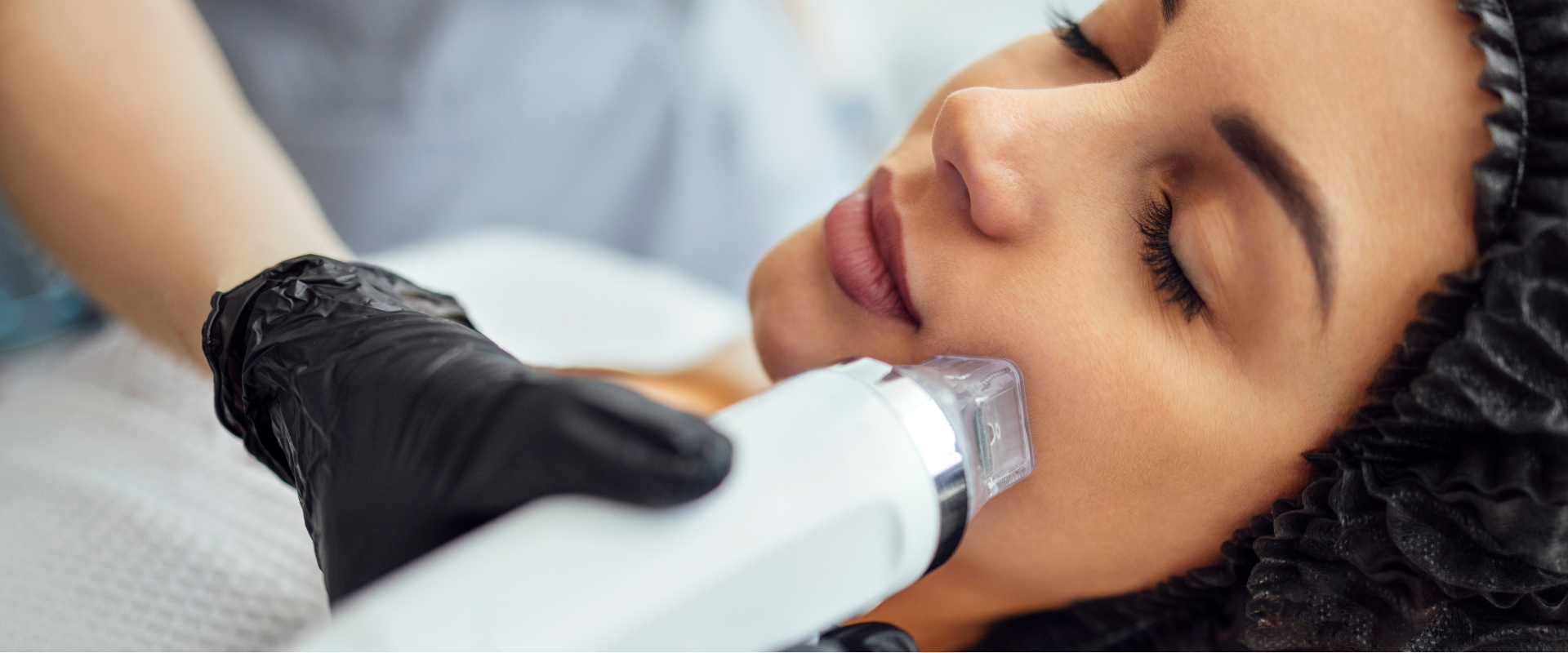
How RF Microneedling Works
Radiofrequency microneedling starts mechanically and finishes thermally. The atrophic scar chapter describes fractional radiofrequency as transmitting bipolar currents through paired microneedles, producing controlled thermal injury and a healing response. The initial injury from inserting the needles is followed by thermal energy delivered as deep as 3.5 millimeters, producing focal epidermal ablation, controlled dermal damage, and consequently new collagen and elastic tissue.
The FDA describes the hardware the same way: an array of small electrodes penetrates the skin and delivers radiofrequency energy to specific depths, with each microneedle producing a small area of intense heat at its tip.
Needles come insulated or non-insulated, which changes where the heat lands. In the non-insulated systems used in the split-face trial cited below, a motor drives the needles to a preset depth and radiofrequency is then emitted in a fractional pulse to heat the dermis while sparing the epidermis. The surface takes a series of small punctures rather than a field of vaporized columns, so less has to grow back.
The Difference That Matters Most in Pigmented Skin
Here is the point most comparisons skip. A laser needs a chromophore, a molecule that absorbs its wavelength. Melanin absorbs efficiently across much of the spectrum, so in skin with more melanin, more energy is intercepted in the epidermis than the plan intended, and the resulting inflammation can push melanocytes to make still more pigment. Radiofrequency has no such dependency. The split-face investigators state it directly: unlike lasers, which target a specific chromophore, radiofrequency is chromophore independent and penetrates to the dermis and hypodermis better than light-based technologies do.
The clinical data track the theory. A meta-analysis of eight randomized controlled trials covering 249 patients, published in the Journal of Cosmetic Dermatology, found a relative risk of post-inflammatory hyperpigmentation of 4.44 for fractional CO2 compared with microneedling radiofrequency, with a 95 percent confidence interval of 2.39 to 8.26. The StatPearls laser review reports that in a study of Fitzpatrick skin types III to V, 45.5 percent of patients developed transient hyperpigmentation after ablative resurfacing, resolving within three months in 90 percent of those affected. The atrophic scar chapter reports post-inflammatory hyperpigmentation below three percent with radiofrequency microneedles.
The American Academy of Dermatology, writing for patients, is unusually direct: it states that both radiofrequency and radiofrequency microneedling are safe for all skin tones, and says the same of microneedling alone. It makes no such statement about laser resurfacing. Mayo Clinic supplies the mirror image, noting that laser resurfacing carries an increased risk of side effects for people with darker skin or a history of keloids.
None of this rules fractional CO2 out in Fitzpatrick III or IV skin; the StatPearls review describes pretreatment with a depigmenting agent such as hydroquinone as one way to reduce that risk in types IV to VI. It does mean pigment risk is a live variable rather than a footnote.
What the Head-to-Head Evidence Shows
Two recent studies frame the trade-off from opposite ends, and reading only one produces a distorted picture.
The meta-analysis found fractional CO2 superior on efficacy: greater scar improvement, with a mean difference of 0.31, and higher patient satisfaction, with a mean difference of 0.32. It also found fractional CO2 significantly more painful, with a mean difference of 2.14 on the pain scales used, carrying the fourfold higher pigmentation risk already described, and followed by erythema lasting on average 1.72 days longer. Its conclusion is that the choice should be individualized to skin type, pain tolerance and recovery expectations.
The split-face randomized study, published in Acta Dermato-Venereologica, enrolled 30 adults aged 18 to 40 with Fitzpatrick skin types III and IV and facial atrophic acne scarring. Each side of the face received one session, one of non-insulated microneedle fractional radiofrequency and one of ablative fractional CO2, with follow-up to six months. The two produced comparable improvement in scar scores, and roughly 95 percent of subjects rated themselves satisfied or very satisfied. Pain was more pronounced on the CO2 side, and measured melanin index, erythema index and red-area values were significantly higher there at one or two months. The radiofrequency arm had milder adverse effects and a shorter recovery period.
Read together, the finding is not that one device wins. Fractional CO2 tends to buy a larger change per session and charges for it in pain, redness and pigment risk; radiofrequency microneedling gives up some of that gain for a gentler recovery. Which trade suits you is a consultation question.
Downtime and Sessions, Realistically
The recovery profiles differ enough to matter to anyone planning around work or travel.
After ablative fractional resurfacing, the StatPearls review describes erythema, crusting, a burning sensation, edema and bruising, with redness and swelling peaking in the first 24 to 48 hours; one cited study reported an average post-treatment erythema duration of about one month. Reepithelialization after carbon dioxide work runs seven to ten days. After radiofrequency microneedling, the atrophic scar chapter describes transient pain, redness, mild swelling and some crusting for up to five days. The FDA's microneedling device page adds dryness, tightness, itching, peeling and bruising as common risks, with pigmentation changes, cold-sore reactivation and infection among the less common ones.
Neither is a single-visit treatment. The atrophic scar chapter reports a literature consensus that three to six radiofrequency sessions produce optimal effect, with improvement in the range of 25 to 75 percent, and states that repeat treatment is necessary for fractional laser used on its own. Mayo Clinic notes that results from energy-based procedures can be subtle.
Neither Device Answers Every Scar
Ice pick scars are the hard case for both. The StatPearls review states that raised and shallow boxcar scars improve the most with laser resurfacing, while ice pick scars are more challenging and may require secondary resurfacing. The atrophic scar chapter says ice pick and hypopigmented scars do not respond optimally to radiofrequency microneedling in terms of restoring volume.
The techniques that do address them are mechanical rather than energetic:
- Punch excision removes a discrete deep scar full-thickness and closes the defect along relaxed skin tension lines, converting a pit into a fine line that resurfacing can later blend. Defects larger than 3 millimeters are handled by elliptical excision instead.
- Punch elevation, for boxcar scars with sharp edges and a normal base, raises the floor level with surrounding skin.
- Subcision severs the fibrous bands tethering the dermis, the specific mechanism behind rolling scars, at some risk of subcutaneous nodule formation.
- Chemical reconstruction of skin scars applies very high concentrations of trichloroacetic acid focally, reported as effective in boxcar scars in particular.
- Fillers add volume, but the chapter is blunt: they offer little on their own, and tethering must be released first or the defect can look worse.
The literature trend favors combination treatment for the more severe grades. The useful question is not which machine a clinic owns, but which of your scars will be treated mechanically first and which with energy afterward.
Safety Signals Worth Knowing Before You Book
On October 15, 2025, the FDA issued a safety communication stating that serious complications have been reported with certain uses of radiofrequency microneedling devices, including burns, scarring, fat loss, disfigurement and nerve damage, some requiring surgical repair. Its evaluation is ongoing. Its advice travels well: treat radiofrequency microneedling as a medical procedure rather than a cosmetic one, seek a licensed provider trained on these devices, and ask which device will be used.
The agency's microneedling device page adds practical questions. Ask how the device is cleaned between patients, and whether a new needle cartridge is used for each patient and each session, because cartridge reuse is unsafe. It lists situations in which microneedling may not be suitable, including bleeding disorders, immune suppression, uncontrolled diabetes, active infection or cold sores, a history of keloids, recent isotretinoin use and pregnancy — and specifically flags darker skin types, noting that some authorized devices were not studied in those subjects.
For ablative laser, the StatPearls review lists contraindications including oral retinoid use within the past year, pregnancy, immunosuppression, connective tissue disorders and concurrent skin disease at the treatment site, and recommends antiviral prophylaxis for anyone with a history of herpes simplex. The atrophic scar chapter notes that the traditional six-month isotretinoin waiting period has been challenged by more recent reports — a judgment for the treating physician.
Sequence Still Beats Device Selection
One constraint applies to radiofrequency microneedling in particular: the atrophic scar chapter states it is contraindicated where any active acne is present, because of the risk of spreading infection to unaffected skin. The Academy adds that scar treatment typically starts once acne is controlled, and asks patients to disclose every acne treatment used in the previous two years, because starting some scar treatments soon after certain acne medications can cause unwanted side effects.
What YONSEI LEEDS CLINIC Publishes About Scar Lasers
YONSEI LEEDS CLINIC in Seocho-gu, Seoul, publishes a scar and spot removal laser service. Within it, the clinic describes carbon dioxide laser for raised or textured lesions, erbium laser for more superficial work with less thermal spread, and fractional carbon dioxide laser specifically for acne scars, hypertrophic scars and textural irregularities through controlled collagen remodeling. Surgical excision with biopsy is the published route for deeper or atypical lesions.
The clinic states that no laser is applied before the lesion's nature, depth and suitability have been assessed, and that the modality is selected according to lesion characteristics rather than applied universally. It states that laser depth and settings are calibrated to individual skin type, and it names post-inflammatory hyperpigmentation as a genuine consideration with carbon dioxide laser, particularly in Fitzpatrick IV to VI skin. It states that scar conditions generally require multiple sessions and that outcomes are not guaranteed to be free of scarring or pigmentation changes. Topical anesthetic cream may be applied for roughly 20 to 40 minutes where appropriate, and scar-resurfacing sessions may take about 20 to 45 minutes. Published aftercare centers on wound hygiene and strict sun avoidance.
One point needs stating precisely, because the search phrasing invites confusion. Patients researching this comparison often type a specific radiofrequency microneedling brand name into the query. That platform does not appear in the clinic's published technology list. What the clinic does publish is InMode, described as a radiofrequency system for body contouring and skin remodeling. This article therefore does not state that the clinic performs radiofrequency microneedling for facial acne scars, because that is not documented. Ask directly if it is what you want.
Regulatory status deserves the same care. Radiofrequency microneedling devices are Class II devices cleared through the FDA's 510(k) process, and the FDA has authorized microneedling devices to improve the appearance of facial acne scars, facial wrinkles and abdominal scars in patients aged 22 or older. Authorization is national and attaches to specific devices and body areas: a device in routine use in Seoul is not thereby authorized for cosmetic use in the United States, and nothing here asserts such clearance for any platform the clinic names. The FDA adds the caveat covering every aesthetic device — a procedure may not always give you the results you want, and effects may be temporary.
What the Clinic Does Not Publish
Several things a careful reader would want are absent from the published record, and naming them beats guessing. There is no contraindication list for laser treatments, no recovery timeline for the laser category, no anesthesia detail beyond the topical cream note, and no session count for a given scar grade. There is no case volume, years-in-practice figure or revision policy, and no device serial-verification or authentication program, so do not assume one exists. Travel logistics, accommodation and payment arrangements are not published either.
On credentials, the clinic describes Dr. In-Ho Khang as a board-certified specialist without naming the issuing board. Treat that as the clinic's own statement rather than as independently verified, and ask to see the certificate at consultation, since Korea does not maintain a public individual specialist registry a reader in the United States can search. His doctor profile page records an MD from Yonsei University College of Medicine and the role of Chief Academic Director of Plastic Surgery at the Korean Society of Aesthetic Surgery and Laser. The clinic separately holds Korean registration as a medical institution for attracting foreign patients under the Ministry of Health and Welfare — an administrative registration, not a quality accreditation, and without standing in the United States.
Planning a Course of Treatment From the United States
The structural problem is arithmetic. Atrophic scar work is a course, not an appointment: three to six sessions for radiofrequency, repeat sessions for fractional laser used alone, spaced weeks apart. One trip to Seoul buys an assessment and a session, not a finished result.
The clinic's main site lists a Seocho-gu address roughly one minute from Gyodae Station Exit 12, open 10:30 a.m. to 8:00 p.m. Monday through Friday and 10:00 a.m. to 4:00 p.m. Saturday, closed Sundays and public holidays. Seoul runs roughly 13 to 17 hours ahead of the continental United States. The clinic states that pre-arrival teleconsultation, English-speaking support and remote follow-up are available, and its inquiry page is the published route for arranging them.
The CDC's Yellow Book chapter on medical tourism supplies the general cautions: discuss the plan with your own physician well before travel, check what your insurance covers abroad, agree in advance who handles complications, and request copies of overseas records in English. It notes that vacation activities such as sunbathing during recovery can impede healing — a pointed warning after resurfacing, where sun exposure drives pigmentary change. On flying, it reports that the American Society of Plastic Surgeons recommends waiting seven to ten days after laser treatments or cosmetic procedures to the face, eyelids or nose. That is general society guidance, not a policy this clinic publishes.
The Bottom Line
- Fractional CO2 ablates microscopic columns of tissue and contours scar edges; radiofrequency microneedling delivers heat through needles into the dermis while largely sparing the surface. Different mechanisms, different trade-offs.
- A meta-analysis of eight randomized trials found fractional CO2 produced greater scar improvement and satisfaction, with more pain, a relative risk of post-inflammatory hyperpigmentation of 4.44, and erythema lasting about 1.72 days longer. A split-face trial in Fitzpatrick III and IV skin found the two comparably effective after one session.
- Radiofrequency is chromophore independent, which is why the Academy describes it and radiofrequency microneedling as safe for all skin tones while noting the added pigment risk of laser resurfacing in darker skin.
- Ice pick and tethered rolling scars respond poorly to either device alone; punch excision, subcision and focal trichloroacetic acid usually come first.
- The clinic publishes fractional carbon dioxide laser for acne scarring and names pigmentation risk in Fitzpatrick IV to VI skin as a genuine consideration; it does not publish a radiofrequency microneedling platform, a contraindication list, a recovery timeline or a session count.
Frequently Asked Questions
Which one gives better results for acne scars?
It depends which result you are measuring. A meta-analysis of eight randomized trials found fractional CO2 produced greater scar improvement and higher patient satisfaction, while a split-face trial in Fitzpatrick III and IV skin found the two comparably effective after a single session. The consistent finding is that fractional CO2 costs more pain, more redness and more pigment risk for whatever additional gain it delivers.
I have medium-toned or olive skin. Does that change the answer?
It changes the risk side of the equation. The meta-analysis reported a relative risk of post-inflammatory hyperpigmentation more than four times higher with fractional CO2, and the split-face trial measured significantly higher melanin and erythema readings on the CO2 side at one and two months. Fractional CO2 is still used in these skin types with adjusted parameters and strict sun protection, but the pigment question belongs at the center of the conversation.
Will either treatment fix my ice pick scars?
Usually not on its own. Published guidance describes ice pick scars as the most challenging type for laser resurfacing, sometimes requiring secondary resurfacing, and reports that they respond suboptimally to radiofrequency microneedling in terms of restoring volume. Punch excision or focal trichloroacetic acid generally addresses them, after which resurfacing can blend the result.
How much downtime should I plan for?
For ablative fractional carbon dioxide, published sources describe reepithelialization over seven to ten days and erythema that in one study averaged about a month. For radiofrequency microneedling, pain, redness, mild swelling and crusting are described as lasting up to about five days. Individual recovery varies.
How many sessions will I need?
More than one, whichever you choose. Published consensus for fractional radiofrequency is three to six sessions, with reported improvement in the range of 25 to 75 percent, and repeat treatment is described as necessary for fractional laser used alone. YONSEI LEEDS CLINIC states that scar conditions generally require multiple sessions, without publishing a count for any scar grade.
Can these treatments be done while I still have active breakouts?
Radiofrequency microneedling is described as contraindicated where any active acne is present, because of the risk of spreading infection to unaffected skin. More generally, dermatologic guidance is that a scar plan begins after acne is controlled, and that you should disclose every acne medication used in the past two years before scar treatment starts.
Is radiofrequency microneedling considered safe?
It has a favorable tolerability profile in the comparative studies and it carries documented risks. In October 2025 the FDA issued a safety communication reporting serious complications with certain uses of these devices, including burns, scarring, fat loss, disfigurement and nerve damage, with its evaluation ongoing. Its guidance is to treat this as a medical procedure, choose a trained licensed provider, and ask which device will be used.
This article is for general informational purposes and does not constitute individualized medical advice, and it is not a self-diagnosis tool. Surgical candidacy, technique, and expected outcomes can only be determined through a consultation with a qualified plastic surgeon.
More Articles
Continue reading our clinical guides.
Why Korea Body Contouring Prices Stay Low Despite Global Inflation Rise
While global inflation has driven up the cost of surgical procedures in many Western markets, Korean body contouring clinics have maintained stable pricing through efficiency and modern liposuction protocols.
Learn More
Breast Fat Grafting Costs: Korea vs Japan Price Comparison 2026
Autologous breast fat grafting uses a patient's own fat cells to enhance breast volume and shape. Compare 2026 breast fat grafting costs and SVF systems in South Korea vs Japan.
Learn More
Body Lift Efficacy: 90% Satisfaction in Korean Reconstruction Studies
The human body undergoes profound structural modifications following significant weight loss, childbirth, or natural structural aging. Learn how high-precision body lift surgery in Korea achieves 90% patient satisfaction.
Learn More